How a Lake Can Structure a Resort Masterplan
A good resort is not a collection of buildings placed in nature. In this lakefront masterplan, water becomes the central organizing element, shaping movement, program, and atmosphere into one coherent landscape system.
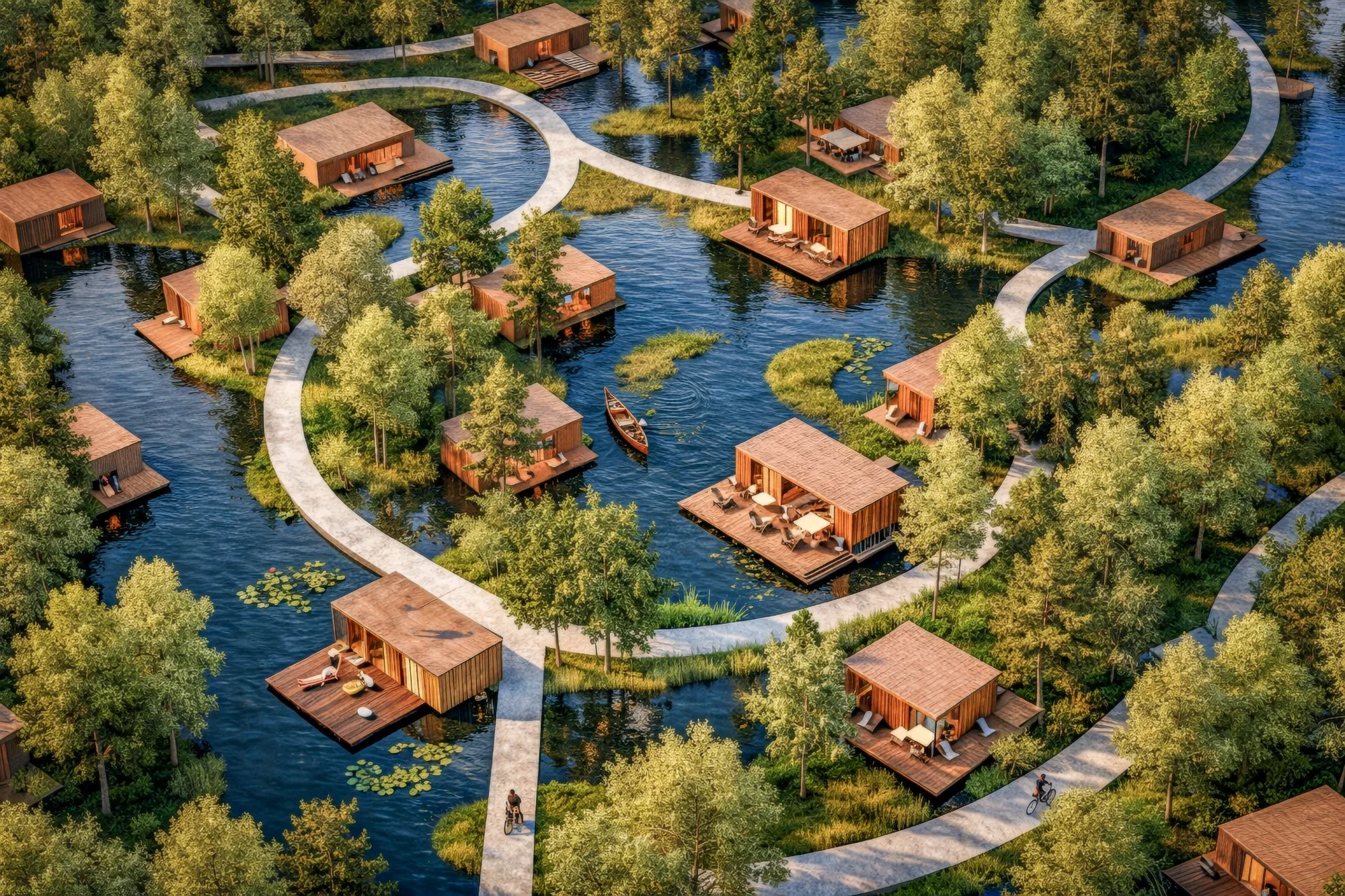
A good resort is not a collection of attractive buildings placed in nature. It is a landscape system with a clear spatial logic.
In many hospitality projects, the program is decided first: hotel, spa, cottages, restaurant, sports, beach. Then these elements are distributed across the site. The result is often functional, but rarely memorable. The territory feels filled rather than composed.
In this project, we worked differently. We began from the lake.
The project, which we call Lakefront Resort Masterplan, rethinks the resort as a sequence of landscape scenarios organized around water. The lake is not treated as a decorative center or as a simple amenity. It becomes the main spatial structure of the project. It determines where activity concentrates, where calm begins, how people move, how views open, and how different programs relate to one another.
This shift is important. As soon as water becomes the organizer rather than the background, the whole masterplan gains coherence.
The lake as the central organizing element
The site is long and linear, running along the water. That condition suggested a simple but powerful strategy: instead of scattering functions evenly, the project is organized as a progression of intensities.
The most public and active functions gather around the main lake. Here the resort forms its social heart: beach, event spaces, spa, restaurant, hotel, children's zones, and water-based public life. The lake becomes the place where the project is most collective and visible.
From there, the territory gradually changes character. Movement continues through a network of winding paths that connect more specialized and quieter areas: fishing cabins, cottage zones, sport fields, gardens, greenhouse, event lawns, and more intimate natural spaces.
This means the masterplan is not read as a static plan of objects. It is read as a continuous experience. The visitor moves from one atmosphere to another, from open social life to quieter retreat, while remaining inside one coherent landscape structure.
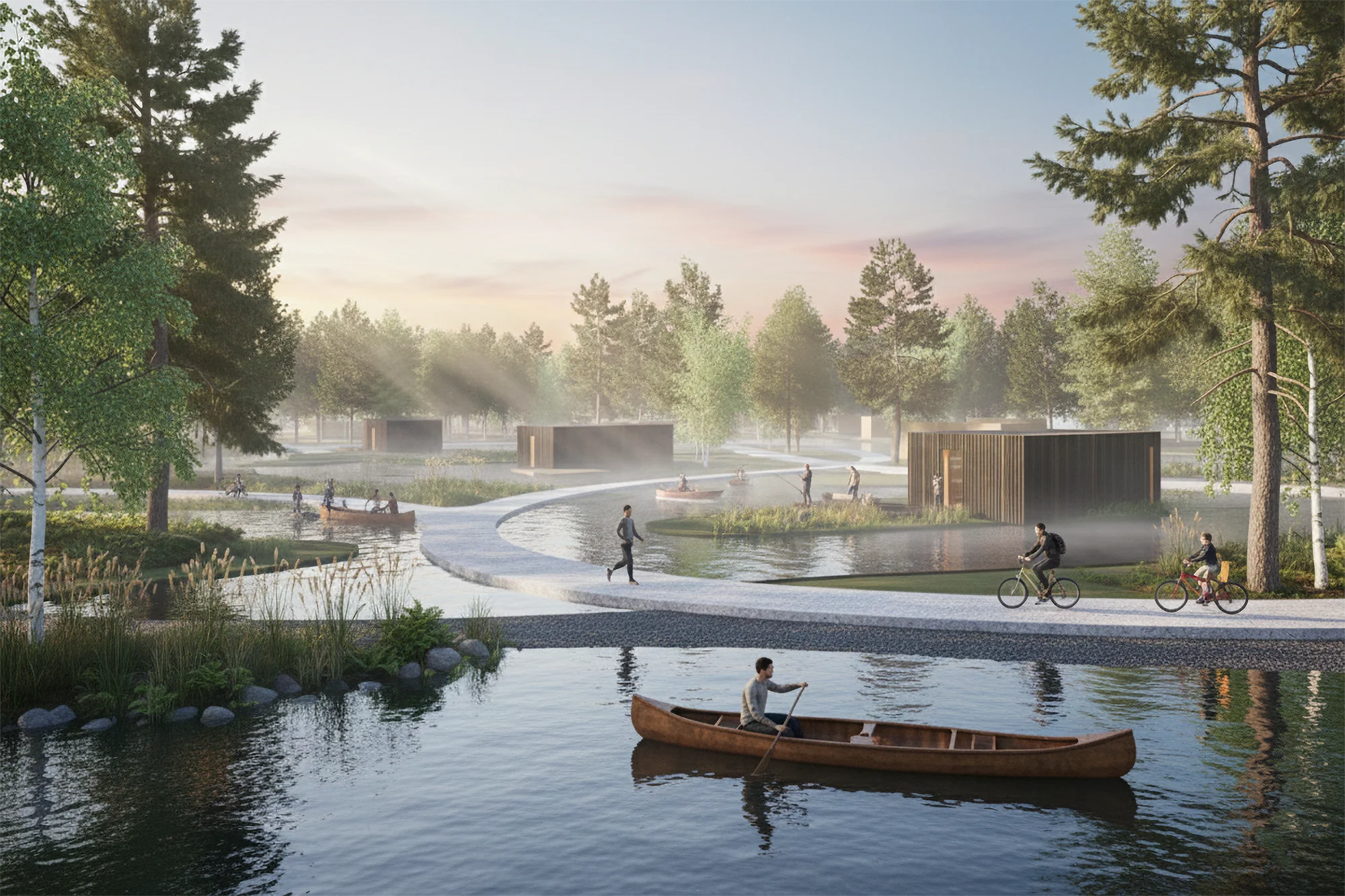
A resort as a sequence, not a cluster
One of the central ideas of this project is that a resort should not be designed as a cluster of unrelated attractions. It should be designed as a sequence.
That sequence matters because leisure is not one condition. People want different kinds of experience: arrival, discovery, gathering, swimming, walking, rest, privacy, family activity, quiet observation, sport, evening atmosphere. A strong resort gives these experiences a spatial order.
In this project, the order is built through the lake edge and the path system. The shoreline is not treated as a fixed border. It is shaped, extended, thickened, and varied. Some parts become beaches. Some become promenades. Some become ecological edges. Some become places for cabins and fishing. The result is a shoreline with different characters rather than a single repetitive condition.
This is what gives the territory depth. The project does not simply place functions near water. It creates multiple ways of being near water.
From public center to private retreat
A successful hospitality masterplan needs gradients. Not everything should have the same level of exposure, noise, and access.
That is why this project is organized from more public and active zones to more calm and secluded ones. Near the central lake, the atmosphere is open, collective, and event-oriented. This is where the resort presents itself. It is the visible heart of the destination.
Further away, the experience becomes quieter. The fishing cabins and more intimate cottage areas are embedded deeper in the landscape. They remain connected to the main system, but they are protected from the most intense public activity. This allows the project to serve different users without conflict: day visitors, hotel guests, families, spa visitors, sport users, and people seeking silence.
The result is not separation for its own sake. It is controlled coexistence.
That is one of the main roles of a masterplan: not just placing functions, but allowing different forms of use to strengthen rather than disrupt each other.
Water, ecology, and experience in one system
In many resort developments, ecology is added after the main concept is finished. In this project, ecology is part of the spatial structure from the start.
The lake, wetlands, planted edges, islands, and green corridors do not only improve the appearance of the territory. They shape movement, visual experience, microclimate, and the atmosphere of the project. Water and vegetation are not secondary layers. They are active design instruments.
This matters economically as well. A stronger landscape structure usually creates a stronger destination image. It improves the quality of stay, increases the diversity of use, and makes the project more memorable. In hospitality, memorability is value.
A guest may not describe the project in technical language, but they will feel whether the territory has rhythm, coherence, and identity.
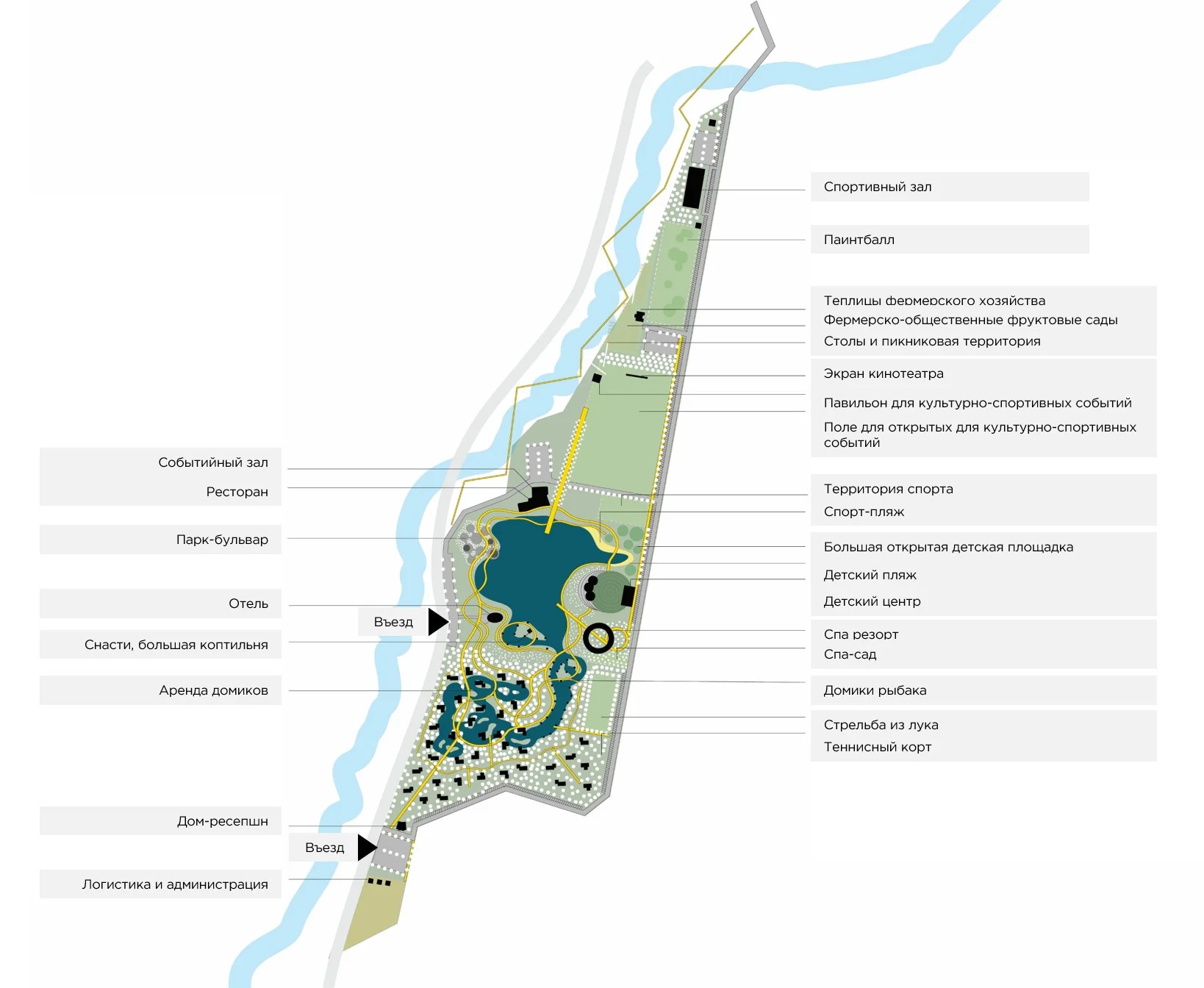
Why the shape of the lake matters
An important part of the design process was testing different lake geometries.
The form of the lake is not neutral. A more compact shape creates one kind of experience. A more extended shoreline creates another. The number of accessible waterfront edges, the visual connections across the water, the possibility of islands, bridges, beaches, and quieter inlets — all of these depend on geometry.
By studying multiple configurations, we could test how the lake might best support both public life and spatial richness. The goal was not to make a picturesque outline for its own sake. The goal was to find a form that could intensify visual relationships, increase the number of active waterfront conditions, and produce a broader spectrum of uses, from open collective zones to intimate retreat spaces.
This is where masterplanning becomes architectural. Even before detailed building design begins, the project already has form, sequence, and atmosphere.
Architecture follows the territorial logic
Once the lake and landscape structure are clear, the architecture can become more precise.
The hotel, spa, restaurant, event spaces, and cabins are not just placed on empty land. They emerge from the territorial logic. Public buildings take positions that reinforce the central collective identity of the lake. Smaller units occupy calmer edges where proximity to water feels more private and immersive. Supporting functions are distributed in a way that keeps the experience legible and practical.
This gives the architecture more force. Buildings do not need to overperform formally when the territory itself is already doing strong spatial work.
That is often the difference between a convincing resort and a weak one: not how iconic each building is on its own, but whether the entire site has been organized with enough intelligence.
A masterplan that makes the landscape usable
The deeper ambition of this project is simple: to turn a piece of land into a coherent leisure environment without destroying its natural character.
The project does not oppose nature and program. It uses program to reveal the potential of the landscape. It does not treat the lake as scenery. It uses the lake as structure. It does not arrange attractions randomly. It builds a sequence of scenarios.
This is what a good resort masterplan should do. It should create a place where ecology, movement, hospitality, and economic logic reinforce each other.
In this project, the lake is not just the center of the image.
It is the center of the idea.
If you are developing a resort, hospitality destination, or leisure territory and want a masterplan that works from landscape logic rather than building placement, we can help shape the concept from the first strategic phase.