How to design a forest resort outside the city
A forest resort is designed through five readings of the site before any architecture: topography, acoustics, walkability, visual porosity, cultural memory.
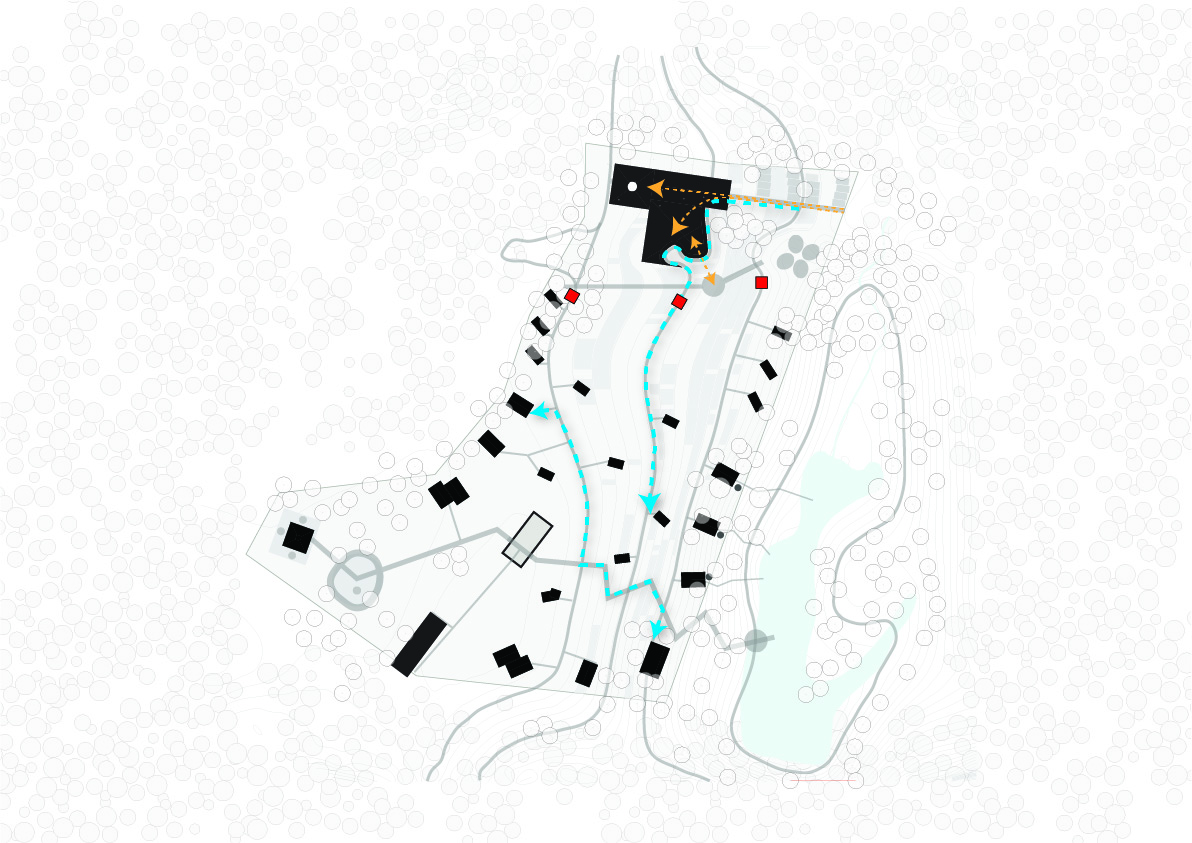
A forest resort is designed through five readings of the site before any architecture. Topography (where the ground is dry, where it holds water), acoustics (where the forest absorbs sound, where it carries it), pedestrian distance (everything walkable without vehicles), visual porosity (what shows through the trees and what is screened), and cultural memory (what was there before). Light infrastructure follows: contour trails, cabins rotated to individual views, programme magnets at the remote corners of the site. Lex te Loo Architects applied this method on Террасы, a 6-hectare forest resort concept south of Moscow on the site of a former Soviet children's camp.
The forest is the structure, not the backdrop
A mature pine forest works as a structural material, not as decoration[1]. It already has its own rhythm of light, wind, and humidity, its own sound landscape, its own network of paths, and its own clearings where the trees have already moved aside. These conditions do not have to be invented; they have to be read and built into the plan.
This shifts the design order. First we fix what is already on the site. Then we place infrastructure that amplifies the existing conditions. Buildings come last. At Террасы near Stupino every placement followed this sequence, from the 25 to 30 rental cabins down to the 750 m² main hotel cluster.
Five readings before the first building
Before any building enters the plan we record five parameters of the site. Each one produces clear placement rules, and each one matters equally on a forest resort.
Topography determines where the ground is dry, where it holds water, where the slope allows building, and where the soil should not be touched. Acoustics determines where the forest absorbs sound and where an open clearing carries it across hundreds of metres. Pedestrian distance determines which destinations need to be reachable without vehicles, and in which season. Visual porosity determines what shows through the trees and what is screened by trunks. Cultural memory determines what was on this site before and which traces are worth keeping.
At Террасы all five readings landed in a single early-stage document. Every subsequent design decision was checked against it.
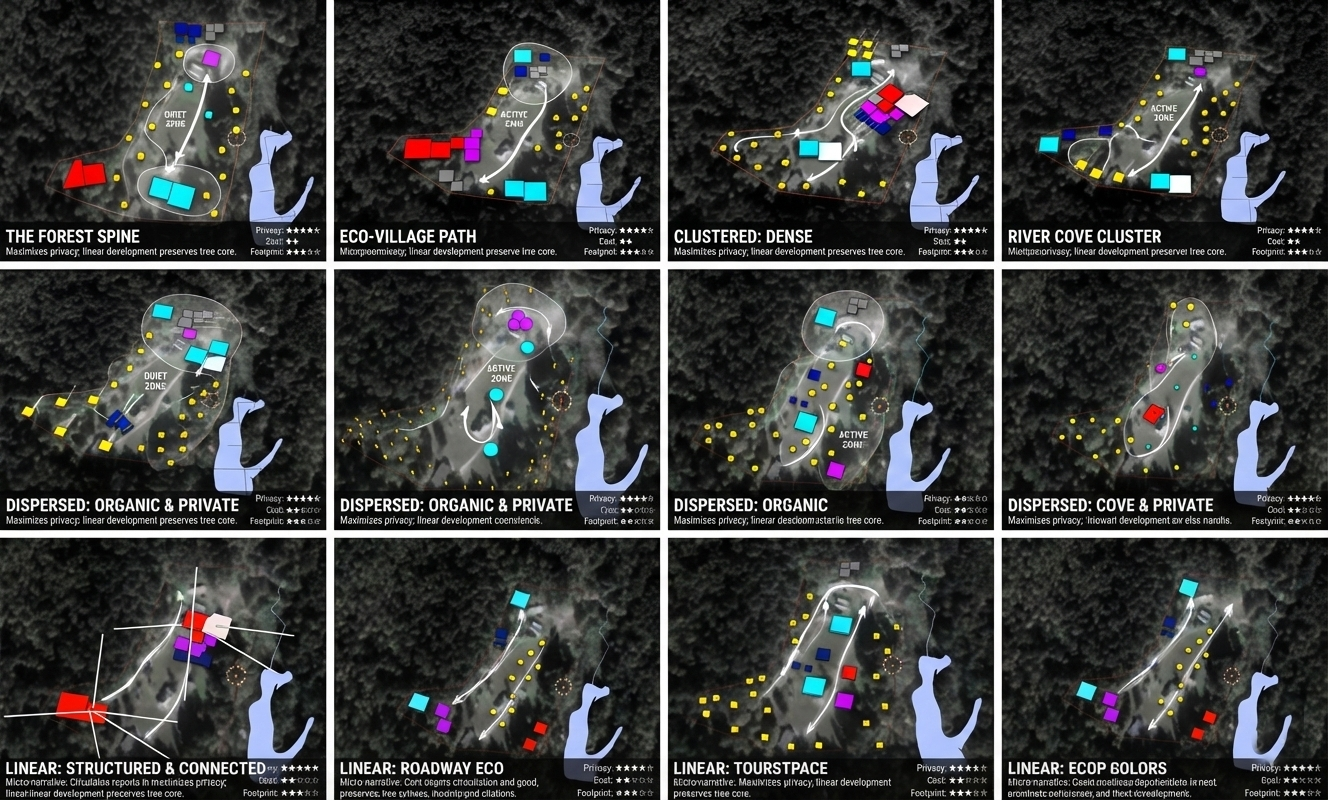
Topography: how to read a forest site
Topography in a forest is read through two overlaid maps: contour lines and a soil-moisture map. Contour lines show where water naturally drains and where shallow basins form. The soil-moisture map shows where the ground stays dry through the seasons and where it has held water in the moss layer for years.
At Террасы this pair of maps produced one of the defining decisions: a landscape terrace system of approximately 8,756 m² running along the contours of the site rather than across them. The terraces organised drainage, separated programme zones, and became the plan's landscape identity. The geometry emerged from the site's own relief rather than being imposed on top.
Light foundations under every structure preserved the moss layer and the underground flow. Cars stopped at the entrance.
Acoustics: how to hear the forest before you draw
Acoustics on a forest resort matter more than solar orientation. Deep forest absorbs sound exceptionally well. Open clearings carry it across kilometres[2]. The forest edge works as a one-way absorber: sound moving from the thicket toward a clearing is dampened; sound moving from a clearing into the thicket reaches the next cabin.
We map the site's acoustic landscape before placing any building. Kitchen exhausts go on the lee side of each cluster so smells and noise drift away from the sleeping cabins rather than toward them. Programme points capable of collecting people and volume (the event hall, the agora, the pool) are moved away from the quiet clusters by acoustic distance, not by code distance.
At Террасы this works in tandem with the operational model: Immersive Mode and Active Mode alternate by calendar so the loud programme does not overlap with the quiet one.
Pedestrian links, visibility, and cultural memory
The remaining three readings determine how the guest moves through the site and what they see.
Pedestrian distance sets the trail network. On a 6-hectare territory everything can be walked without vehicles, which removes asphalt, parking, and engine noise from the most valuable part of the resort.
Visual porosity determines what the architecture shows. On a forest resort the window works as a moment rather than as a wall. Each cabin is rotated to a single specific view (into the canopy or toward the water)[3], and none look toward the next cabin. This pulls intimacy out of the landscape instead of panorama, and holds 25 to 30 cabins on the site without crowding.
Cultural memory determines what is preserved from the past. At Террасы that means the former Soviet pioneer camp, with its A-frame cabins, school building, and floating water platform. These traces are reinterpreted into the new plan rather than erased.
Trails, cabins, magnets, in that order
After the readings comes the light infrastructure, placed in a strict order.
First, contour trails. They become the first geometry of the plan and define how everything else is organised. The trails curve with the site, they do not run straight, and they become part of the user experience themselves.
Then the cabins, each in its individual rotation. The window is aligned to a single view. The veranda takes a position in the forest. No cabin opens toward another. Each sits on a light foundation that does not disturb the moss layer.
Only then come the programme magnets at the edges of the site. At Террасы the hammam is in the far western forest, the panoramic spa on the south side overlooking the water reservoir, the wooden agora is offset from the main cluster, and the pool barn stands on its own. The guest reaches each magnet through the landscape, and the walk itself becomes part of the product.
The main hotel cluster is placed last, on the elevated northeastern corner of the site near the entrance: a 750 m² hotel, a 500–800 m² lobby and restaurant, and a 230 m² private spa.
What the client receives
A forest resort concept by Lex te Loo Architects contains a defined package: a five-axis site reading, a landscape structure (terraces, trails, water), cabin designs with a view study for each, placement of the principal buildings, programme magnets at the corners, an operational model, and a guest scenario.
At Террасы the package shipped in two stages, a sketch in December 2025 and a full concept in January 2026, after which it moves to Stage P contractors with the forest and the existing landscape as the primary structure of the plan.
Closing
A forest resort is designed in the reverse of what most clients expect. First the site is read; then the light infrastructure is placed along the existing lines; only then do the buildings arrive. The forest works as the structure of the project, and the architecture does not replace it.
Sources
1. Prach, K., Ujházy, K., Knopp, V., & Fanta, J. "Two centuries of forest succession, and 30 years of vegetation changes in permanent plots in an inland sand dune area, The Netherlands." PLOS ONE 16, no. 4 (2021): e0250003. journals.plos.org. Accessed 2026-05-28.
"Species diversity peaked after about 40 years of forest succession, then declined."
2. Swearingen, M. E., & White, M. J. "Influence of scattering, atmospheric refraction, and ground effect on sound propagation through a pine forest." Journal of the Acoustical Society of America 122, no. 1 (2007): 113–119. pubmed.ncbi.nlm.nih.gov. Accessed 2026-05-28.
"Sound propagation through a forest is affected by the microclimate in the canopy, scattering by trunks and stems, and ground reflection."
3. Kaplan, Stephen. "The Restorative Benefits of Nature: Toward an Integrative Framework." Journal of Environmental Psychology 15 (1995): 169–182. doi.org/10.1016/0272-4944(95)90001-2. Accessed 2026-05-28.
"Natural environments turn out to be particularly rich in the characteristics necessary for restorative experiences."
Lex te Loo Architects: an architecture practice founded in 2018, based between the Netherlands and Russia. The bureau is led by Lex te Loo, MArch (Cum Laude) from TU Delft, with exchanges at ETH Zurich and the office of B. V. Doshi (Sangath, India), and a former researcher at The Why Factory under Winy Maas. The practice works on concept design, masterplanning, and territorial concepts for projects up to 250,000 m², in the phase when form, programme, and direction are still open and architecture can shape the whole project. The bureau method is Metropolitan Intelligence and Geological Presence: precise reading of urban and territorial forces, transformed into architecture with clear logic and strong presence. The Террасы forest resort concept in Moscow Oblast was designed in 2026.