How to Turn a Seasonal Resort into a Year-Round Destination
A seasonal resort runs all year when its program is split into four clusters with different peaks. The Astrakhan Hills method, in detail.
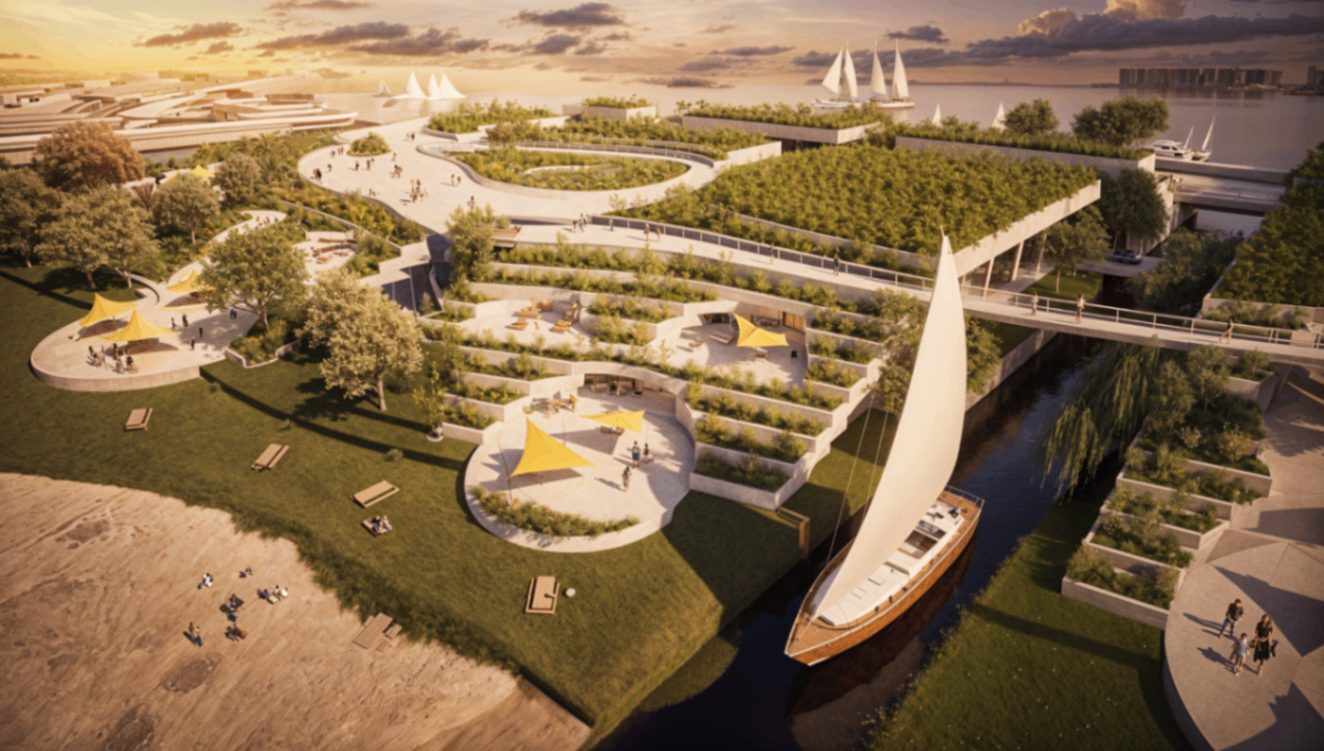
A seasonal resort becomes a year-round destination when its program is split into clusters that peak in different months. In Astrakhan Hills, our thirty-hectare Volga island masterplan, we organised four clusters — urban economy, sport, agriculture, and recreation — across roughly 297,000 m² of ground area. Operators cross-support each other through shared economics, so the site does not collapse outside the summer. Lex te Loo Architects treats seasonality as design material, not as a problem to be hidden.
Why the conventional resort model breaks outside of summer
The conventional resort masterplan — a row of hotels along a beach — concentrates all economic activity into three or four summer months. [1] By autumn the beaches empty, the restaurants close, the staff disperse, and the infrastructure sits idle for nine months. By the second year this becomes a financial problem: operators cannot cover fixed costs, the program stops renewing itself, and the place loses its connection to the surrounding city.
This trap cannot be solved with better architecture later. It is solved at the concept stage, while the program is still open and other seasonal cycles can still be built into it.
Four clusters that keep an island alive year-round
In our competition concept for Proletarsky Island on the Volga, twenty minutes from the historic Astrakhan Kremlin, we organised the program into four clusters. Each cluster has its own peak month and its own audience.
The urban-economy cluster gathers the city-facing functions: lecture halls, exhibition halls and classrooms for educational and cultural programmes, from seminars to festivals; a theatre, exhibition spaces and craft workshops; administrative and rental offices; shops and co-working. This cluster ties the island to the everyday life of Astrakhan and runs independently of the tourist season.
The sports cluster holds year-round facilities, scaled for training, education and competition at multiple sizes. Sport is not weather-dependent in the way beaches are: it works in winter as actively as in summer.
The agricultural cluster is built around research into effective farming methods, education programmes, and the study and preservation of local Astrakhan biomes. Its second function is producing food for local markets and restaurants on the island itself. The agricultural calendar follows its own annual rhythm and does not coincide with the tourist peaks.
The recreation cluster is the most outward-facing: hotels, beaches, restaurants, promenades, shops, and entertainment, oriented to the open river and the summer season.
How the square metres are distributed: the Astrakhan Hills schedule
The numbers in the brochure are concrete. Education and culture occupy roughly 50,000 m². Sport: 33,868 m². Hotels: 36,500 m². Recreation and parks: 63,165 m². Total ground floor area is 226,700 m²; with roads, sidewalks and lawns it reaches 296,861 m². On the water, the project adds 23,400 m² of structures and 94,800 m² of walkways and spaces.
These numbers matter not for their own sake, but as evidence that the year-round clusters carry a much larger share of the program than they would in a conventional resort. About half of the ground area is allocated to functions that have nothing to do with summer.
Shared operator economics as a financial instrument
Because the four clusters target different audiences and peak in different months, the project anticipates a system of mutual support between operators from the start. The educational cluster fills the lecture halls in winter, when the hotels are quiet. The recreation cluster carries the cash flow in summer, while the agricultural cycle works through planting and harvest. Sport runs to its own competition calendar.
This is not a marketing gesture. It is a financial model written into the masterplan itself. Without it, collapse is inevitable: no single operator on this site can absorb a nine-month idle period.
A spatial system strong enough to hold four programs
Four clusters can coexist on a single thirty-hectare island only because there is a strong spatial system underneath them. In Astrakhan Hills that system is a four-step method, in which the existing relief of the island is first scaled up to the volume needed for the full program, then cut by a grid of canyon-streets that bring daylight, river views and a sheltered microclimate inside the depth of the island, and finally left as inhabitable hills into which the functions are carved. Program follows the spatial system, not the other way round.
Without that system, four clusters become four separate projects competing for the same site. With it, they become one body.
What year-round operation changes in the form of the masterplan
When the program is split across seasonal clusters, the form of the masterplan changes. Areas stop being distributed by the rule of "as many hotel rooms as possible." Circulation must be planned so the clusters do not interfere with each other while still sharing common spaces. Microclimate becomes critical: the canyon-streets must filter the strong eastern winter wind [2] and admit the summer river breezes, otherwise the winter program does not really work. The orientation of the carved mass is set against solstice diagrams for 21 June, 21 September and 21 December.
Year-round operation is not a feature bolted onto a resort. It is a structural decision that shapes every step of design that follows.
Closing
A resort stops being seasonal when its economics, its audience, and its form are designed for all twelve months at once. Astrakhan Hills shows how this works on a thirty-hectare island that almost disappears under water in spring [3] and returns as an oasis in summer: four programmatic clusters, shared operator economics, and a spatial system strong enough to hold them all as one body.
Sources
[1] Ćorluka, Goran. Seasonality in Tourism — causes, implications and strategies. 2014. Read on Academia.edu.
"The most significant aspect of seasonality is that it involves the concentration of tourist flows in relatively short periods of the year."
[2] Weather Spark. Average Weather in Astrakhan, Russia, Year Round. Reanalysis data: NASA MERRA-2. weatherspark.com.
"The wind is most often from the east for 10 months, from July 27 to June 10, with a peak percentage of 35% on January 1."
[3] Freshwater Ecoregions of the World (FEOW). Volga Delta — Northern Caspian Drainages. WWF / The Nature Conservancy. feow.org.
"Ilmens of the delta are relatively more resistant, and partly retain water even during dry periods, whereas polois exist only during spring floods."
Lex te Loo Architects is an architecture bureau founded in 2018 and operating between the Netherlands and Russia. The bureau is led by Lex te Loo, who graduated Cum Laude from the master's programme at TU Delft, also studied at ETH Zurich and in the office of B. V. Doshi (Sangath, India), and worked as a researcher at The Why Factory under Winy Maas. The practice focuses on concept design, masterplanning and territorial concepts for projects up to 250,000 m², where form, program and direction are still open and architecture can define the entire project. The bureau's method is Metropolitan Intelligence and Geological Presence: a precise reading of urban and territorial forces and their translation into architecture with clear logic and strong presence.