What is the difference between a luxury and a premium resort
Premium and luxury at a resort differ in the direction of energy, not in the budget. Set out on the Террасы forest resort concept near Moscow.
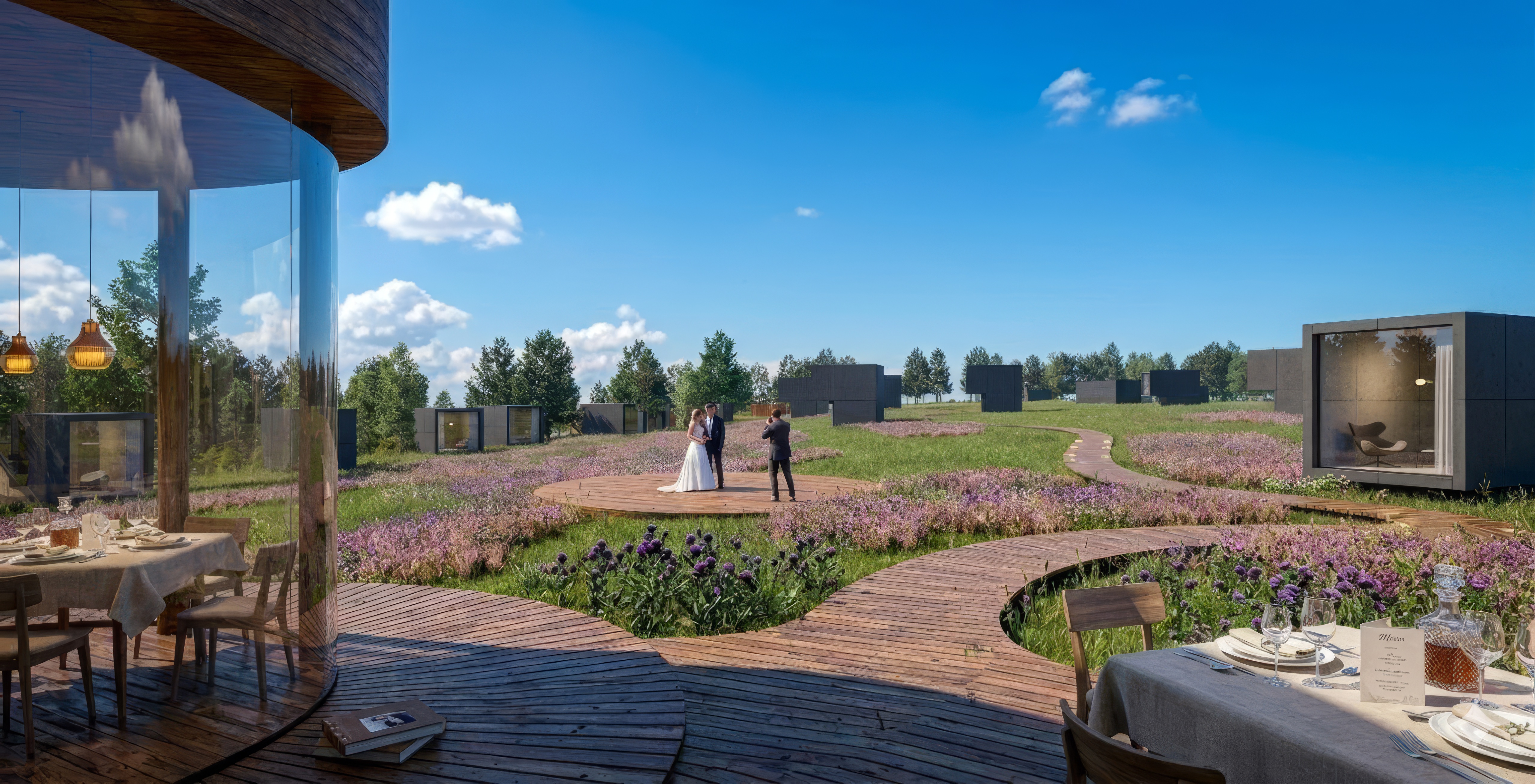
Premium and luxury at a resort differ in the direction of energy, not the size of the budget. Luxury adds: programme, equipment, events, themed restaurants. In that model the place works as a container for imported energy. Premium subtracts: silence, distance, protected landscape. In that model the place works as the source of energy, and the architecture amplifies what is already there. Lex te Loo Architects designed the 6-hectare Террасы forest resort concept near Stupino, 80 km south of Moscow, by exactly this logic: terraces following the existing contours, cabins rotated to one view each, and no programme competing with the forest's silence.
What a luxury resort buys
A luxury resort buys equipment because the place by itself does not deliver enough rhythm. Sound systems, lighting rigs, programmable kitchens, themed wallpaper, animated children's clubs. It buys talent: DJs, sommeliers, mixologists, entertainers, water-sports instructors. It buys event calendars that run from Halloween brunch to summer foam party.
The cost stack grows linearly with the offer. Every season needs new content, every year new equipment. Guests come for what was added; when the additions stop, the guests stop. This is a working business model. It built most of the resorts an hour north of Moscow. It is not the logic that designed Террасы.
What a premium resort buys
A premium resort buys what a luxury resort cannot manufacture. Time: a forest that took forty years to close[1]. Distance: a perimeter of trees that absorbs the sound of neighbours. A water surface that already holds the sky. Soil that already smells of pine. Then it buys judgement, which is the rarer and more expensive purchase.
Judgement is the eye that decides where not to put a building. It is the acoustic ear that places a kitchen exhaust on the lee side of the cluster so smells and noise carry away from the cabins. It is the patience to leave a clearing empty because the clearing is the reason the guest came.
The cost stack in this model does not scale with the offer. It scales with restraint.
How the programme amplifiers are distributed
A luxury masterplan centralises the amplifiers. A large spa inside the main building, an anchor restaurant, a programmed event hall, a pool attached to the hotel. The goal is convenience: everything in one building, minimum movement, maximum staff contact.
A premium masterplan decentralises the amplifiers to the edges of the site. At Террасы south of Moscow the hammam sits in the far western forest, the panoramic spa in the south overlooking the water reservoir, the wooden agora offset from the main cluster, the pool barn standing on its own. Guests walk through the landscape to reach each destination, and the walk itself becomes part of the product. Cars stop at the entrance; no vehicle penetrates the interior.
Luxury sells convenience. Premium sells distance.
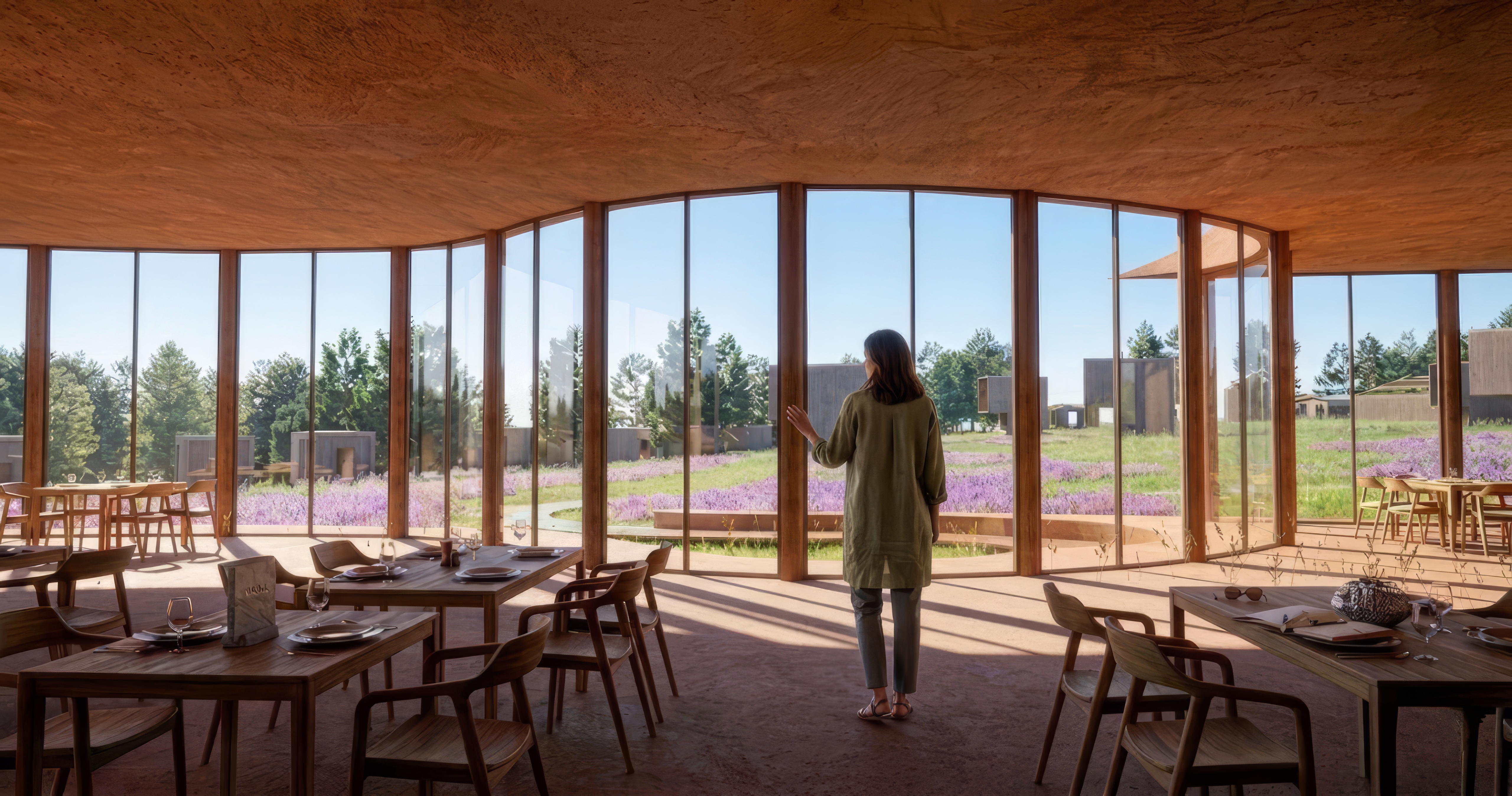
How the atmosphere is protected
A luxury resort protects atmosphere technically: thick walls, soundproofing, air conditioning with a white-noise mode, acoustic glazing. That removes the background noise but does not remove the source.
A premium resort protects atmosphere operationally, by removing the source. At Террасы this runs through a concentric four-ring guest model. Quiet long-stay guests sit at the centre: low volume, high spend, they set the price and define the atmosphere. Small pre-agreed groups occupy the second ring. Weddings and events occupy the third ring with a time buffer in the calendar so their peaks do not overlap with the quiet-guest peaks. Day visitors sit on the perimeter with a spatial buffer and limited access (spa and restaurant only).
Two operational modes, Immersive and Active, alternate by calendar rather than coexisting. This is not a hotel programme in the usual sense. It is a frequency management system. Without it the wedding party bleeds into the quiet zone and the quiet zone collapses.
What the client brief looks like
A luxury brief is mostly about what to add. Which spa brand, which chef, how many restaurants, which entertainment programme, which gift sets in the rooms.
A premium brief is mostly about what not to do. Which vehicles to keep out, which views to keep clear, which paths to leave curved, which clearings to leave empty. At Террасы every decision was a subtraction. No vehicle penetrates the site. No cabin faces another cabin. No building rises above the canopy. No path is straight. No clearing is filled. No event calendar competes with the silence. No product competes with the smell of pine.
The premium is not what was added. The premium is what was not allowed to enter.
What cannot be assembled, only protected
Luxury can be assembled in eighteen months. The developer buys the equipment, hires the talent, prints the brochure, and opens. Premium cannot be assembled at any speed. Premium is grown, recognised, framed, and protected.
A forty-year forest cannot be ordered from a supplier. The acoustic shadow of the Prioksko-Terrasnyi Biosphere Reserve cannot be installed. The historic memory of the Soviet children's camp cannot be commissioned. Either they were there before the project began, or they were never going to be there.
This is why premium requires a site that already had its own energy and an architect with the discipline to leave most of that energy untouched. The brief is mostly about what not to do. The drawings are mostly about where not to build. The budget is mostly about what to protect.
When to choose each model
The luxury model is chosen when the site has no energy of its own: a clean field by the highway, a post-industrial zone, a city office district. In those cases the programme must supply the rhythm because the landscape does not.
The premium model is chosen when the site already delivers most of the product: mature forest, water surface, protected nature reserve, cultural memory of place. In those cases the architecture's task is not to compete with the existing energy but to amplify it and step out of the way.
Террасы near Stupino sits in the second category. Six hectares of forest 80 km south of Moscow on the site of a former Soviet pioneer camp, with a water reservoir on the eastern edge and the Prioksko-Terrasnyi Biosphere Reserve immediately to the northwest[2]. The site was already working. Lex te Loo Architects designed approximately 8,756 m² of terraces following the contours, distributed 25 to 30 cabins each rotated to a single view, placed programme magnets at the corners, and fixed an operational model that lets the landscape do the work.
Closing
An active resort pushes energy into the place. A premium resort lets the place push energy into the guest[3]. The first is a transaction. The second is a transfer. The difference is not in the budget but in the direction of movement, and it is fixed long before the first building enters the plan.
Sources
1. Prach, K., Ujházy, K., Knopp, V., & Fanta, J. "Two centuries of forest succession, and 30 years of vegetation changes in permanent plots in an inland sand dune area, The Netherlands." PLOS ONE 16, no. 4 (2021): e0250003. journals.plos.org. Accessed 2026-05-28.
"Species diversity peaked after about 40 years of forest succession, then declined."
2. Commission of the Russian Federation for UNESCO. "Prioksko-Terrasny Nature Reserve Celebrates Its 80th Anniversary." unesco.ru. Accessed 2026-05-28.
"The reserve's bison nursery adds special value, continuing the important work of preserving this rare animal species."
3. Kaplan, Stephen. "The Restorative Benefits of Nature: Toward an Integrative Framework." Journal of Environmental Psychology 15 (1995): 169–182. doi.org/10.1016/0272-4944(95)90001-2. Accessed 2026-05-28.
"Natural environments turn out to be particularly rich in the characteristics necessary for restorative experiences."
Lex te Loo Architects: an architecture practice founded in 2018, based between the Netherlands and Russia. The bureau is led by Lex te Loo, MArch (Cum Laude) from TU Delft, with exchanges at ETH Zurich and the office of B. V. Doshi (Sangath, India), and a former researcher at The Why Factory under Winy Maas. The practice works on concept design, masterplanning, and territorial concepts for projects up to 250,000 m², in the phase when form, programme, and direction are still open and architecture can shape the whole project. The bureau method is Metropolitan Intelligence and Geological Presence: precise reading of urban and territorial forces, transformed into architecture with clear logic and strong presence. The Террасы forest resort concept in Moscow Oblast was designed in 2026.