What HARIBO Teaches Us About Façades
Four bags in a supermarket aisle as four models of how a façade relates to its building and its context: berry, bear, worm, dragon. A field note.
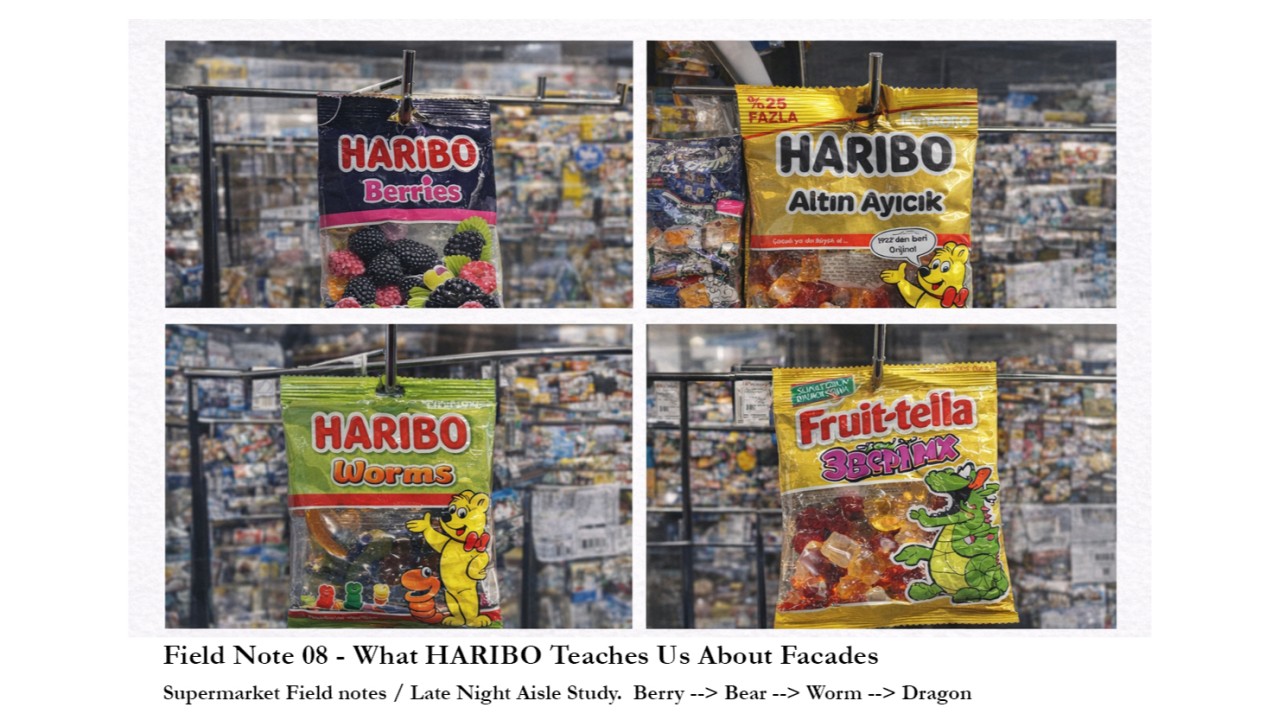
Late at night I went out for toothpaste, to the supermarket at the end of my street. The candy aisle was on the way to the registers. Under the neutral honesty of supermarket lighting, four bags of gummy candy hung from their clips, evenly spaced, evenly lit. The first was dark purple.
The Berry
Woodland berries, the label said. The candy inside was shaped like berries. The photograph on the front showed berries. Object, image, text, aligned.
I took the bag off its clip and held it. The candy resembled the berry. The photograph depicted the berry. And yet the photograph showed berries more perfect than any berry ever picked. Glistening, symmetrical, impossibly lush. Even the "real" berry was already an idealization. Honesty was already a performance of honesty.
I thought about the plaggenhut. The sod houses that stood in Drenthe, in Friesland, in the peat districts of the northeast, where people too poor for brick or stone cut slabs of heather sod from the ground and stacked them into walls. The roof was the same material. The floor was the earth itself. The building was, in the most literal sense, made of the place where it stood. You could not distinguish the façade from the landscape because the façade was the landscape, rearranged vertically. There was no representation involved at all. The building didn't describe its context. It was its context, cut into blocks.
There is something comforting about a structure like that. There is also a limit. A building that only is what it is made of has surrendered every other capacity. It is readable. Contextual. Grounded. And finished before you arrive. The Woningwet banned them in 1901. We moved on. Even the desire for total honesty, it seems, has an expiry date.
I put the bag back on the rail.
The Bear
The second bag was gold.
HARIBO Altın Ayıcık, the Turkish edition of the Goldbears. The packaging was louder, more saturated, more confident. A smiling yellow bear occupied the lower right corner, bow tie, arms open, as if welcoming you not to a product but to a territory. I took the bag down. Inside, small bears in red, orange, yellow, green, white. Fruit-flavoured, the label said. But the bears do not resemble any fruit. They do not resemble any bear, either.
The lineage of this shape does not begin in a forest. It begins in 1902, in Mississippi, during a presidential hunting trip. Theodore Roosevelt was led to a black bear that had been captured, chased by dogs, and tied to a tree for him to shoot. He refused. The refusal was reported. A political cartoonist named Clifford Berryman drew Roosevelt turning his back on the bound animal, and the cartoon ran in The Washington Post. Within months, a Brooklyn toy store owner had placed a stuffed bear in his window with a sign reading "Teddy's Bear." It sold. Then it sold again. Then it became an industry, then a symbol, then a default image of childhood itself.
I turned the bag over in my hand. A real animal, dangerous, territorial, heavy enough to kill a man, was captured, bound, and spared. The sparing became a story about mercy. The story became a cartoon. The cartoon became a toy. The toy removed every trace of danger from the animal: no teeth, no claws, no weight, no smell. What remained was softness, roundness, the emotional residue of a political gesture most people have long forgotten. The Teddy Bear is not a bear. It is a bear from which all bear-ness has been carefully extracted.
HARIBO enters the chain here. Not at the level of the animal, but at the level of the toy. The Goldbear is a copy of a Teddy Bear, which is a copy of a cartoon, which is a copy of a political moment, which is a copy of a failed hunt. Five removes from the forest floor.
And then the brand does something the berry never did. It fuses the candy, the mascot, the logo, the tagline, the colour, everything, into a single atmosphere. The Goldbear is no longer a product on a shelf. It is a climate. You don't evaluate it. You enter it. You participate in a feeling that has been engineered with the same precision as the gelatin formula, and the feeling has a name. The name is happiness, and it is printed on every bag in every language, and it has nothing to do with the taste of the candy, which is mostly sugar and citric acid, but with the world the bear has built around itself, a world so complete it no longer needs the forest, the cartoon, the president, or the tree.
I thought about a resort I worked on once, early in my career. The client's brief used the word experience fourteen times. The lobby was to feel like an arrival. Not at a building, but at a state of mind. Warm stone. Diffused light. A scent piped through the ventilation system. The glass was engineered to eliminate glare so the sea outside looked permanently calm. Every material, every angle, every surface was designed to say: you are safe, you are welcome, the world outside has been temporarily suspended. It was a bear. The whole building was a bear. It did not reference reality. It referenced a version of reality from which all friction had been removed, all weather, all noise, all evidence that anything difficult had ever happened or could happen again.
The façade of that resort did not describe the interior. It described the story the interior wanted to tell about itself.
I hung the gold bag back on its clip.
The Worm
The third bag was green. HARIBO Worms. I picked it up. The candy inside had stretched and lengthened, no longer bear-shaped, striped in two colours, elongated, soft. But the mascot on the corner of the bag was still the yellow bear. Same bow tie. Same wave. The bear had not changed even though the candy had. The bear was doing something different now. The bear was no longer the product. The bear was the climate the product was permitted to exist inside.
I stood with that for a moment. The contradiction did not resolve. It was not meant to. The package held a worm and a bear at the same time, and nobody cared, because once the climate has been established, the climate can absorb anything. The system had become elastic. You could pour worms into the bear-world and the bear-world did not rupture. It widened.
I thought about an airport I changed planes in once, a few years ago. The terminal contained a shopping mall, a food court, a spa, a hotel, a cinema, and, somewhere near the centre, the actual gates. There was a chapel too, a small dim room with a frosted-glass door, two units down from a wall of duty-free whisky. Nobody seemed to find this strange. While I stood there a man came out of the chapel and joined the queue for the whisky. The envelope was a single continuous roof structure, calibrated acoustically and thermally to produce the particular hush of transit. The architecture did not distinguish between its programs. It held them the way the green bag held the worms: under the same yellow bear, in the same climate, with the same smile. It was no longer a building that was also a mall. It was not a mall that was also a building. It was an envelope that had outgrown the question of what it contained, and now hosted contradictions the way weather hosts contradictions, as local conditions inside a larger atmosphere.
I put the worms back next to the bears.
The Dragon
The last bag was not HARIBO.
It was Fruittella. Yellow packaging, the name printed in two alphabets at once, Звери MIX, half Cyrillic, half Latin. On the front, a cartoon dragon. Green, grinning, wearing a small red crest, one claw raised in a wave. Inside, the candies were shapeless, amber and orange lumps, vaguely animal, vaguely geological. They could have been anything.
But the dragon was specific.
A dragon is not an animal. It has never existed. No one has ever encountered one and reported back. But it is not arbitrary either. Look at what it's made of. The body of a serpent, the thing that waited in the trees, coiled above the canopy floor, the oldest predator in primate memory. The claws and teeth of a wolf, the thing that tracked you through the forest, patient, coordinated, always at the edge of the firelight. The wings and talons of an eagle, the thing that struck from above, from open sky, on the steppe where there was no canopy to hide under. And fire, the one force that could destroy everything, shelter included.
These are not random animals. These are the apex predators that co-evolved with us. The snake, the wolf, the raptor, each one sovereign over a different environment, each one the thing that hunted humans across every landscape we ever moved through. Trees, forest floor, open plain. The dragon is what happens when you take everything that has ever been dangerous to the human body and compress it into a single form. It is not a creature. It is the total image of threat, ancient, environmental, complete.
And here it was, grinning on a bag of candy, wearing a little red crest, waving.
I held the bag and felt the distance from the first one. The berry had a photograph of its source. The bear had a genealogy, five removes from a forest, but still traceable, still tethered to a real animal tied to a real tree. Even the worm had a recognisable body, something you could dig up from the garden and hold in your palm. But the dragon has no source. No fossil record. No location on any map.
And then I understood what Fruittella was doing, and it was more ambitious than anything on the HARIBO shelf. HARIBO's trick with the bear was already remarkable. It took one dangerous animal and, through a century of cultural processing, extracted all the danger and replaced it with softness, trust, a smiling mascot. One predator, domesticated into candy. But Fruittella had taken every predator. Every ancestral threat. The entire catalogue of what has ever hunted us, fused into one composite creature, and then given it a cartoon grin and a friendly wave and placed it on a bag of sweets in a supermarket aisle. This was not the domestication of one animal. This was the domestication of danger itself. If you can make a dragon cute, there is nothing left to fear.
I thought about a site visit I made to Qianhai, in Shenzhen, where the Pearl River meets the sea. Fifteen square kilometres of reclaimed land. Mud and shallow water dredged, compressed, and solidified over twelve years until it became ground. Almost the entire district is manufactured earth. I remember standing on a freshly poured concrete slab, looking at a master plan pinned to a temporary hoarding, and reading the words the Manhattan of the Pearl River Delta. The buildings on the plan did not reference the local vernacular, or the climate, or the fishing villages that had existed on the coastline before the coastline was moved. They didn't need to. The land itself was new. The context didn't precede the architecture. They were manufactured together, from the same budget. The architecture didn't arrive in a place. It arrived as a place.
And it had to. Because Qianhai sits at the far western end of a linear city. Shenzhen grew from east to west, from the Luohu border crossing where the first money came in, through Futian, through Nanshan, each new district pulling the centre of gravity further along the coast. Qianhai is the last stop. Thirty kilometres from where the city began. And at that distance, a berry won't work. A building that honestly describes its function will not pull a single commuter, a single investor, a single yuan across the full length of a metropolis. You need a dragon. You need a myth strong enough to bend the city's circulation toward you. It is the same logic as the supermarket I was standing in. The bread is always in the far corner. Not because it belongs there, but because it has to pull you through everything else first. Qianhai is the bread corner of Shenzhen. It can only afford to be a dragon.
Not a building that described what it contained. Not a building that told a story about what it contained. Not a building that absorbed contradictions under a single skin. A building, an entire district, that had no exterior, because there was nothing outside it. It generated its own geography, its own microclimate, its own mythology. The material was concrete and reclaimed sand. The tool was capital. The result was a world as solid and navigable as any city that grew over centuries, except that it had no memory. It was a dragon made of glass and stone, grinning on the horizon, breathing its own weather.
I put the bag back.
The Aisle
The refrigerator hummed. A woman passed behind me pushing a cart with a child asleep in the fold-down seat, head tilted, mouth open, either at the end of a sugar rush or ready for the next one. The price tags were small and yellow and adhesive. The aisle was empty again.
The four bags hung from their clips, evenly spaced, evenly lit. Berry, Bear, Worm, Dragon. I hadn't planned to stand here this long. I hadn't planned to think about façades while buying toothpaste. But something in the sequence had snagged, the way each bag loosened what the previous one had held in place, until the last one held nothing at all, and didn't need to.
I bought the toothpaste. Berry flavour, as it turned out. I walked out through the automatic doors into the parking lot, where the lighting was sodium-orange and the sky was the kind of dark that only exists above retail parks. Not black, not blue, but a bruised, ambient grey, the colour of a city reflecting its own light back at itself.
The doors closed behind me with a soft pneumatic exhale.
Inside, the bears went on smiling at no one in particular. The worms lay still in their green bag. The dragon grinned from its clip, wingless, clawless, made of sugar, and entirely real. And the berries, the berries sat in their dark purple packaging, looking so much like real berries that you might forget they weren't.