Hospital Green
The piece critiques the limitations of language in describing spaces, particularly in hospitals. It argues for a future where architecture communicates through gradients and sensations rather than fixed terms.
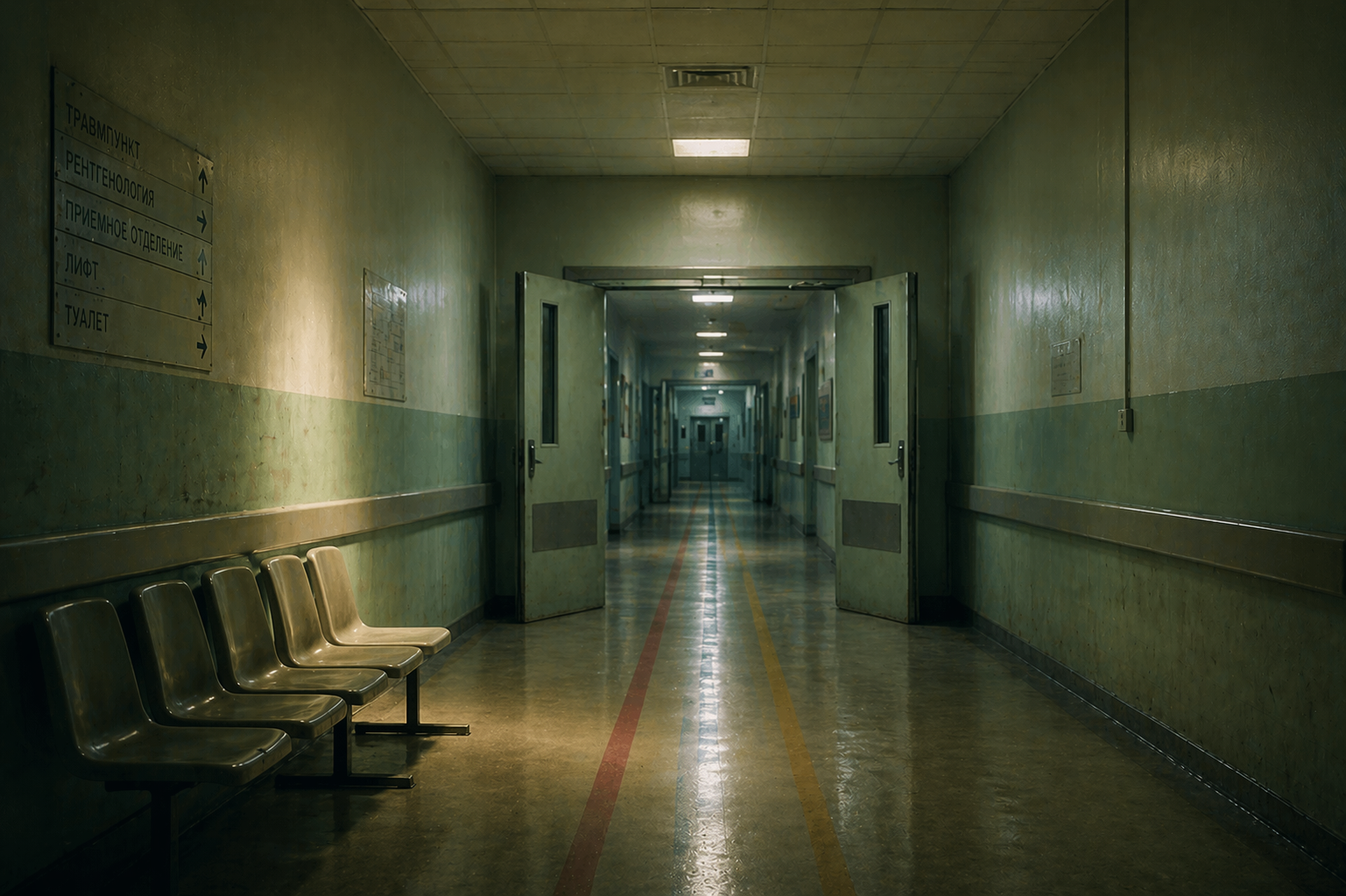
I thought as I walked into the hospital, as I approached the desk, as I sat on the plastic chair waiting, I thought about the walls and how I would call them green when they weren't green, not really, but I would still call them green because that's what we do, because I can't say what they really are, that color that exists only in institutions, that pale mint that has given up on being a color, that green that is closer to despair than to green, and yet if you said hospital green to anyone they would know, they would see it, and if you said it to a Russian he would see a different green, a worse green, a green with more corridors in it, more waiting, more linoleum, a green that has absorbed decades of fluorescent light and breathing and silence, and he would be right, and you would be right, and both greens would be called green, because we have no other word, because we cut the spectrum into pieces and this piece we call green, twenty shades if we are ambitious, thirty if we're extravagant, but never a thousand, because we can't hold a thousand, because a thousand is too many, so we say green, and we sit against it, and we wait.
And I followed the lines on the floor, the red line and the blue line and the yellow line, those painted strips that tell you where to go without telling you anything, red to trauma, blue to radiology, yellow to something I never learned, and I thought how strange it is that we navigate an entire building by color, by the same crude system we teach children, three lines, three destinations, as if the body moving through a hospital could be sorted into three streams, as if illness were that simple, as if the distance between the plastic chair and the operating theatre could be measured in colors, and I followed the blue line around a corner, past that green that is not green, and the line didn't stop, it just went, certain of itself the way only painted things are certain.
And then the doors, those doors, the double doors at the end of every corridor, heavy and swinging, built to be hit not opened, and I heard them before I saw them, that thick flap of rubber on rubber, the ambulance crew pushing through with the brancard, not slowing, never slowing, because those doors are not doors, they are thresholds designed to be broken, designed to swing wide and slam shut and swing again, flap flap flap, quieter each time, like the body settling after a shock, and I stood against the wall, against that green, and I watched them pass, and I thought this is it, this is the threshold we pretend doesn't exist, the crossing from corridor to corridor that is actually the crossing from one state to another, from waiting to urgency, from stable to critical, from blue line to no line at all, and no one tells you when you've crossed, and the doors just flap and settle and go still.
And I thought about those walls again, that green that every hospital has chosen as if by silent agreement, that green that was supposed to calm but only numbs, and I thought how one day we won't need that green, because the walls won't be walls, they'll be gradients, and we won't say corridor or ward or waiting room, we'll say something closer to what the space is doing, we'll say meet me at the low-crease fold where the tangent doubles, we'll say turn at the soft deviation, and there will be no painted lines on the floor because the floor itself will pulse, gently, a contraction that moves you forward without you deciding to move, and the spaces will narrow and widen the way passages narrow and widen, tight where the flow must accelerate, wide where it must pool and slow, and temperature will rise at the thresholds, warm where the walls press close, cool where they release, and you will move through the building the way something moves through something alive, carried and resisted and carried again, and the chair was hard under me while I thought this, hard and plastic and certain, and the body will know, the way it already knows in this hospital, already changes configuration when those doors flap open, walking becomes standing-aside becomes pressing-against-the-wall, three configurations in two seconds, no sign needed, no painted line, just the sound of rubber hitting rubber and the brancard passing and the body rearranging itself because the threshold told it to, because thresholds don't need language, they need only a gradient steep enough to feel, cold to warm to hot, calm to tense to move, blue to purple to red, the way the monitors do it, the way the line on the screen slides from blue to red and everyone in the room knows what it means without being told, because the gradient screams.
And I sat on the plastic chair again, and I followed the blue line with my eyes, and I listened for the doors, those flapping doors that are already the threshold that needs no name, only force, only the weight of a brancard and two hands pushing, and the green walls stood there the way they have always stood, not green, not calm, not anything we have a word for, and I thought what I thought when I walked in, as I approached the desk, as I sat down to wait, that I would call these walls green when they weren't green, not really, but that I would call them green anyway, because that's what we do, and I sat against it, and I waited.