(All) Aluminium. A Manifesto.
Architecture thinks it needs twenty materials. It needs one. A manifesto for mono-material building in aluminum: panels that carry air, electricity, waste, water and heat; rooms that become weather; cities that carry their own light.
I. The proposition.
Architecture thinks it needs twenty materials. It needs one.
Aluminum conducts heat better than any common metal except copper. It carries electricity. It reflects 90 percent of visible light and 95 percent of infrared. It folds, extrudes, anodises into any colour, recycles forever, and covers 8 percent of the earth's crust. After a century of cheap supply, architecture has used it mostly as the frame around a window.
This manifesto proposes that it should carry everything a building is, and everything a building could become.
II. The element.
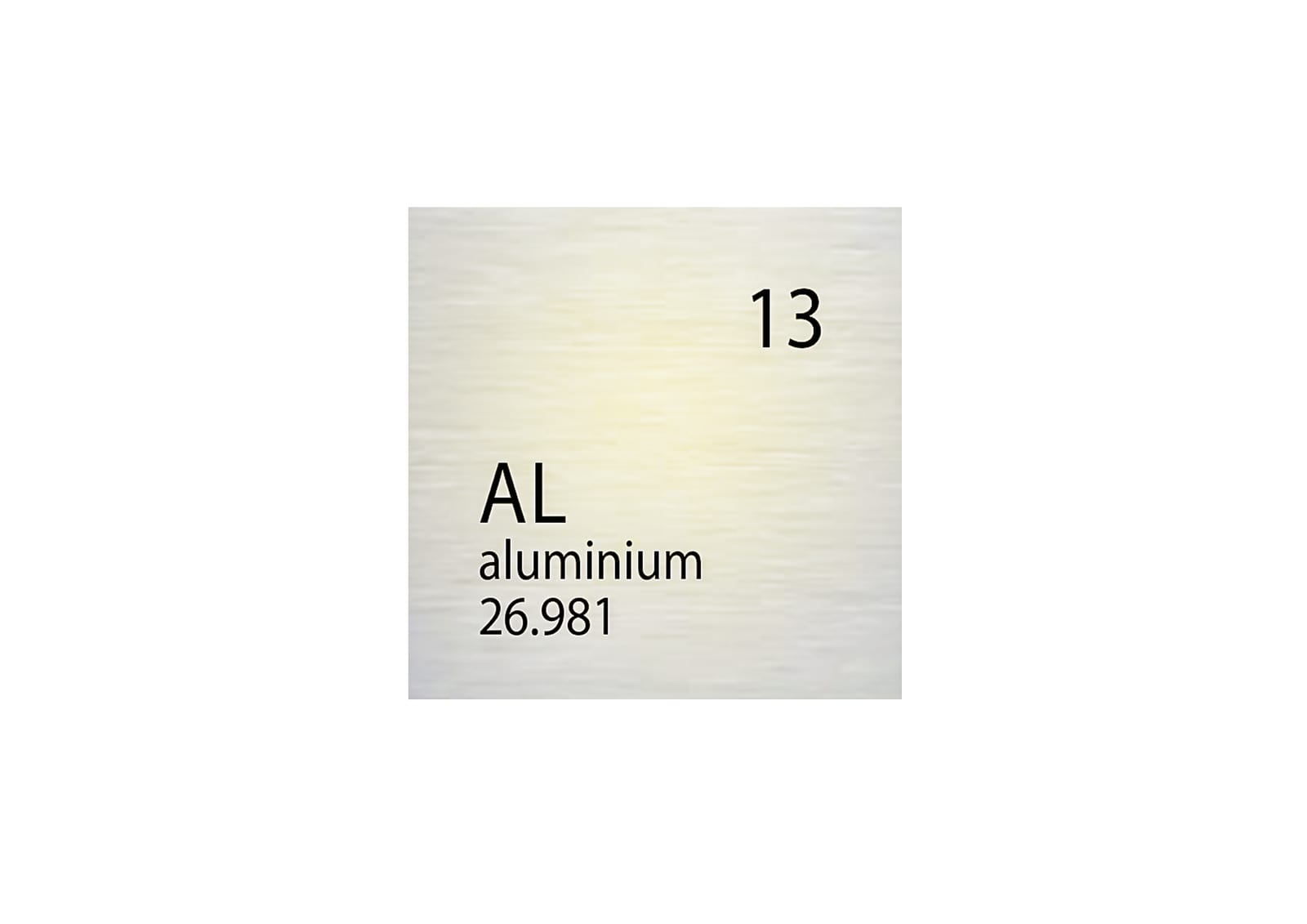
Aluminum was isolated in 1825 by Ørsted and industrialised by Hall and Héroult in 1886. The tip of the Washington Monument was cast in aluminum in 1884 because at that moment it cost as much as silver. Forty years later it was a commodity. Seventy years after that it is the second most produced metal on earth, and still largely absent from the imagination of buildings.
The element's properties are almost impossible to combine in one material. Thermal conductivity 237 watts per metre-Kelvin. Electrical conductivity so favourable by weight that every long-distance power line on the planet is aluminum. A surface that can be mirror or mountain, transparent or opaque, soft to the touch or cold as flint. A self-healing oxide layer 2 to 5 nanometres thick, closing in microseconds wherever the hand scratches it. Infinitely recyclable, at a twentieth of its first-melt energy.
No other material offers this combination. A single element waiting for a grammar.
III. The panel.
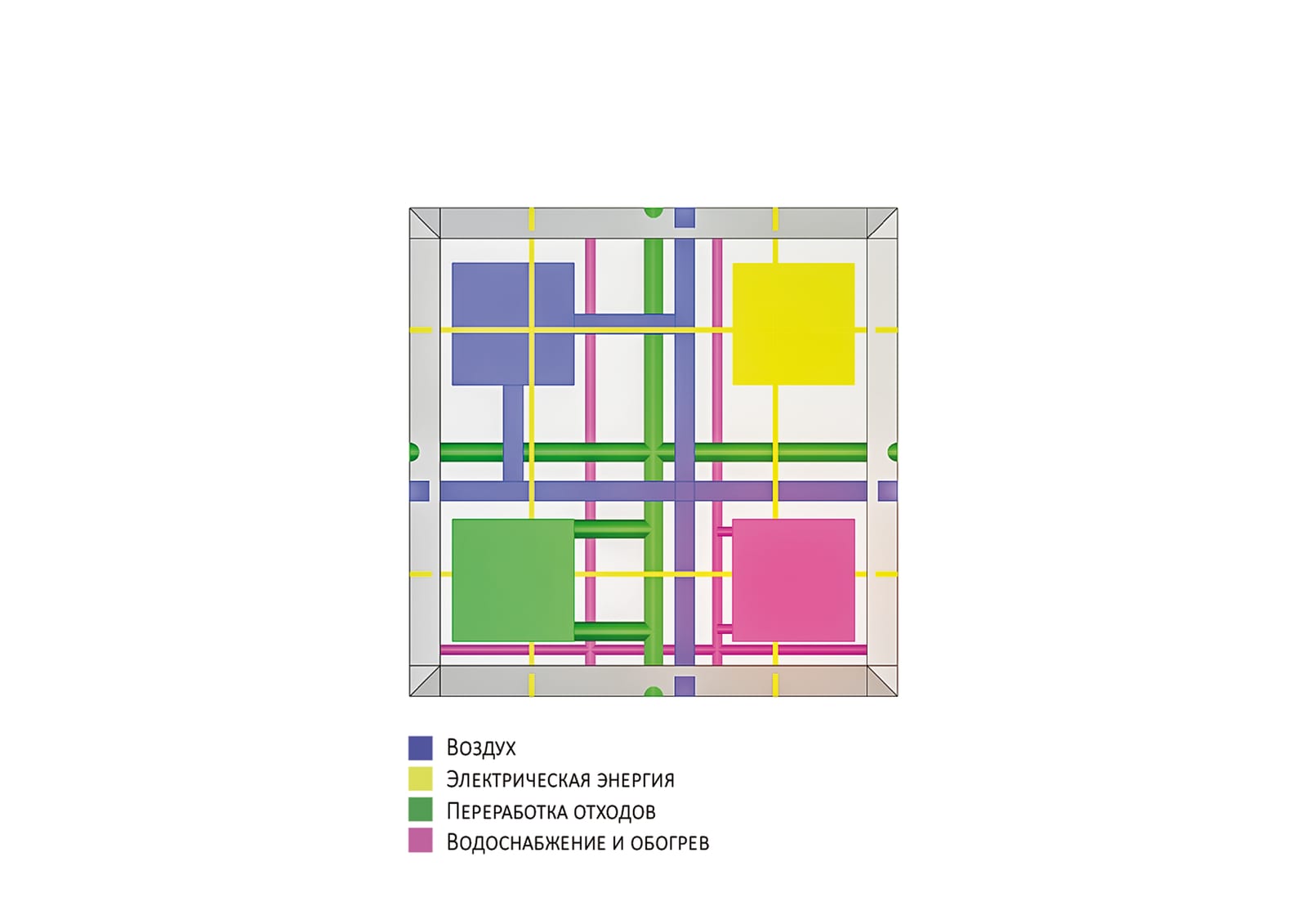
The unit of the system is a panel. 2.4 metres tall, 1.2 metres wide, roughly the size of a door. On the face, 4 millimetres of anodised aluminum, textured as the room requires: mirror, matt, woven, perforated, mountain-rough or river-smooth. Behind the skin, four reservoirs.
- Air. Ventilation supply and return, heat-recovered from the room next door.
- Electricity. A low-voltage busway, tapped at any point without tools.
- Organic waste. A vacuum channel pulling kitchen scraps toward a building-scale digester, returning nutrients to the roof.
- Water and heat. A hydronic loop carrying potable water, greywater, and heating fluid in separate circuits, shared with the neighbours.
Every panel holds all four. Every panel clicks to the next. Every panel unclips in a minute. The services layer and the structure layer are the same layer. This is the hinge of the manifesto. Every miracle that follows rests on it.
IV. The room.
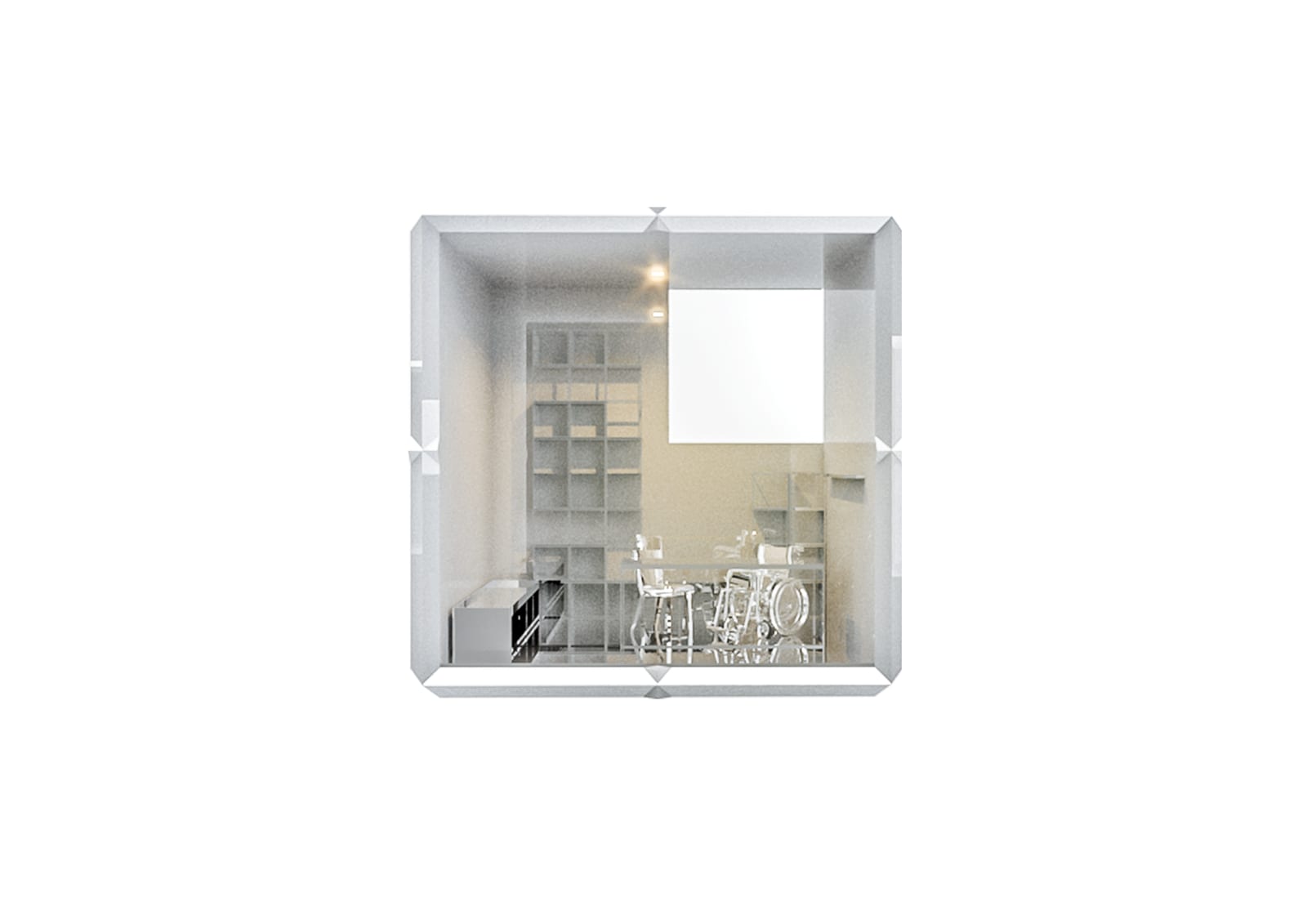
Twenty-four panels make a room. Six faces, four panels per face. The reservoirs fuse at the edges. The room becomes an organ.
Kurokawa's Nakagin Capsule Tower, Tokyo 1972, proposed something similar in welded steel: capsules bolted to a concrete core, replaceable on a 25-year cycle. The replacement never happened. The idea was right and the material was wrong. Aluminum, clicked and gasketed, treats replacement not as a repair but as a way of living. The wall you lived with last winter is not the wall you will live with this summer.
V. The building that becomes weather.
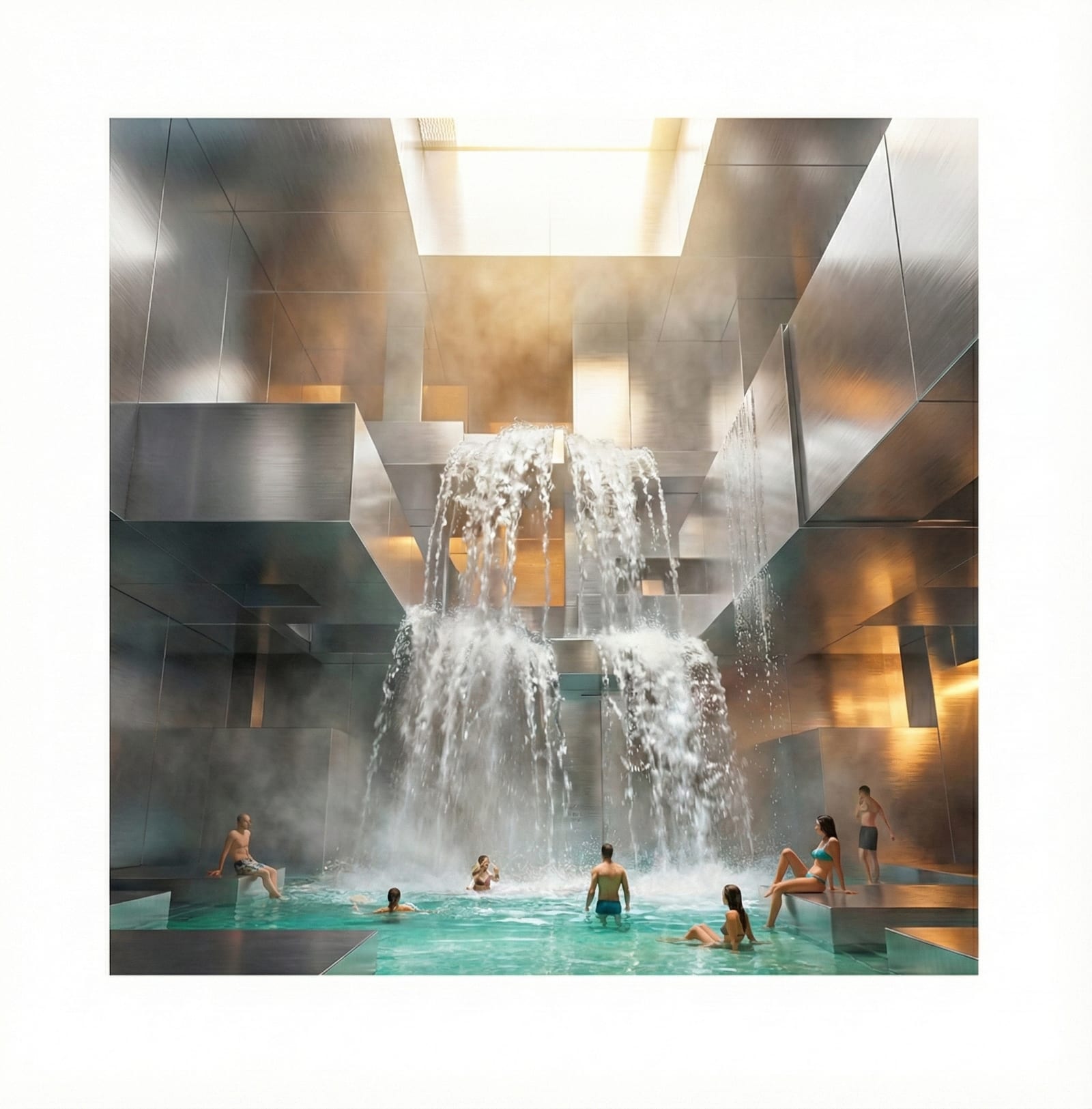
Now the building stops being a building.
Because aluminum holds and moves every flow a room needs (heat, water, air, electricity, organic matter, light), the architecture is no longer fixed. The room is not one room; it is a room that can be any room. The building is not one climate; it is a building that can become any climate.
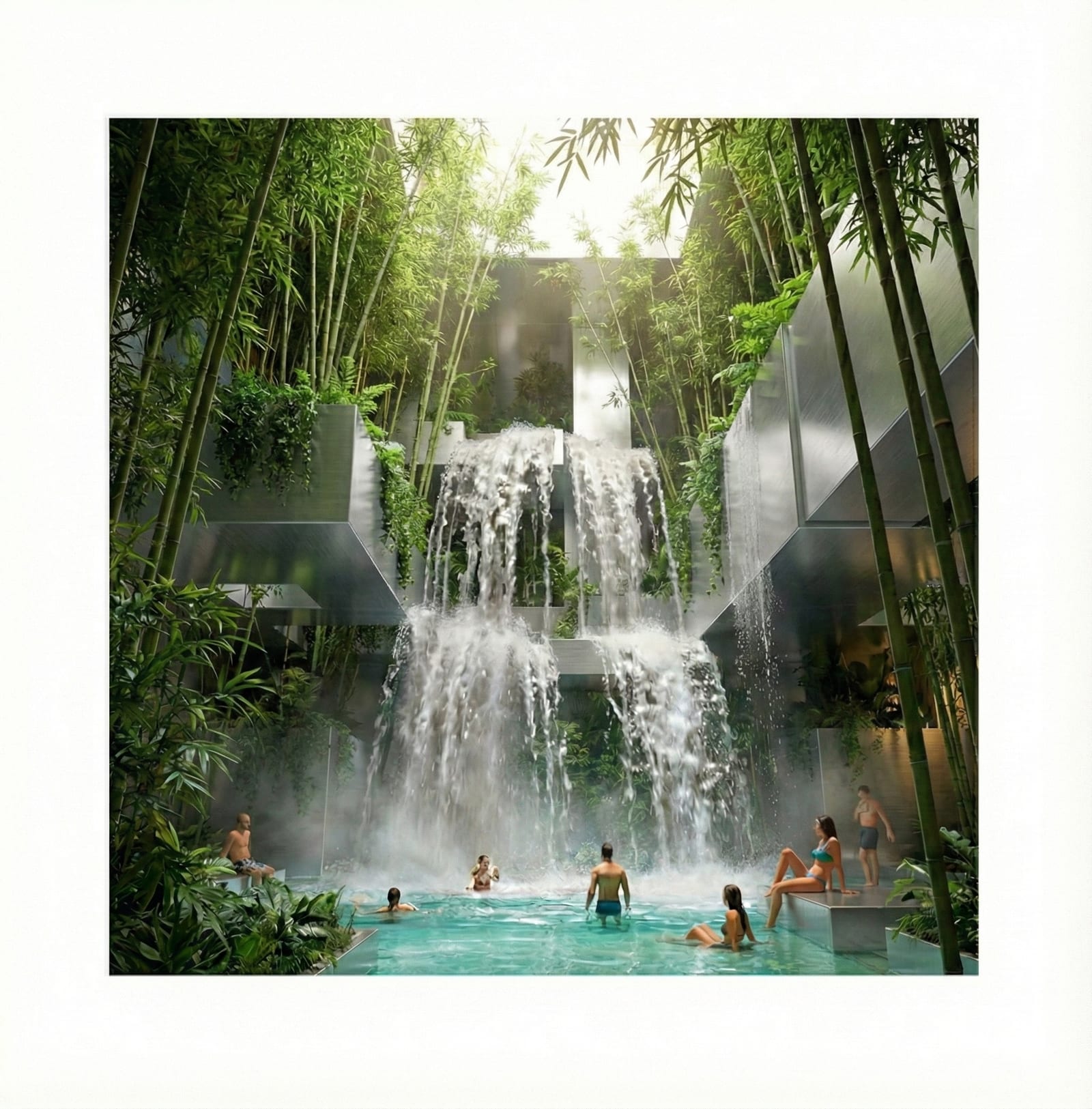
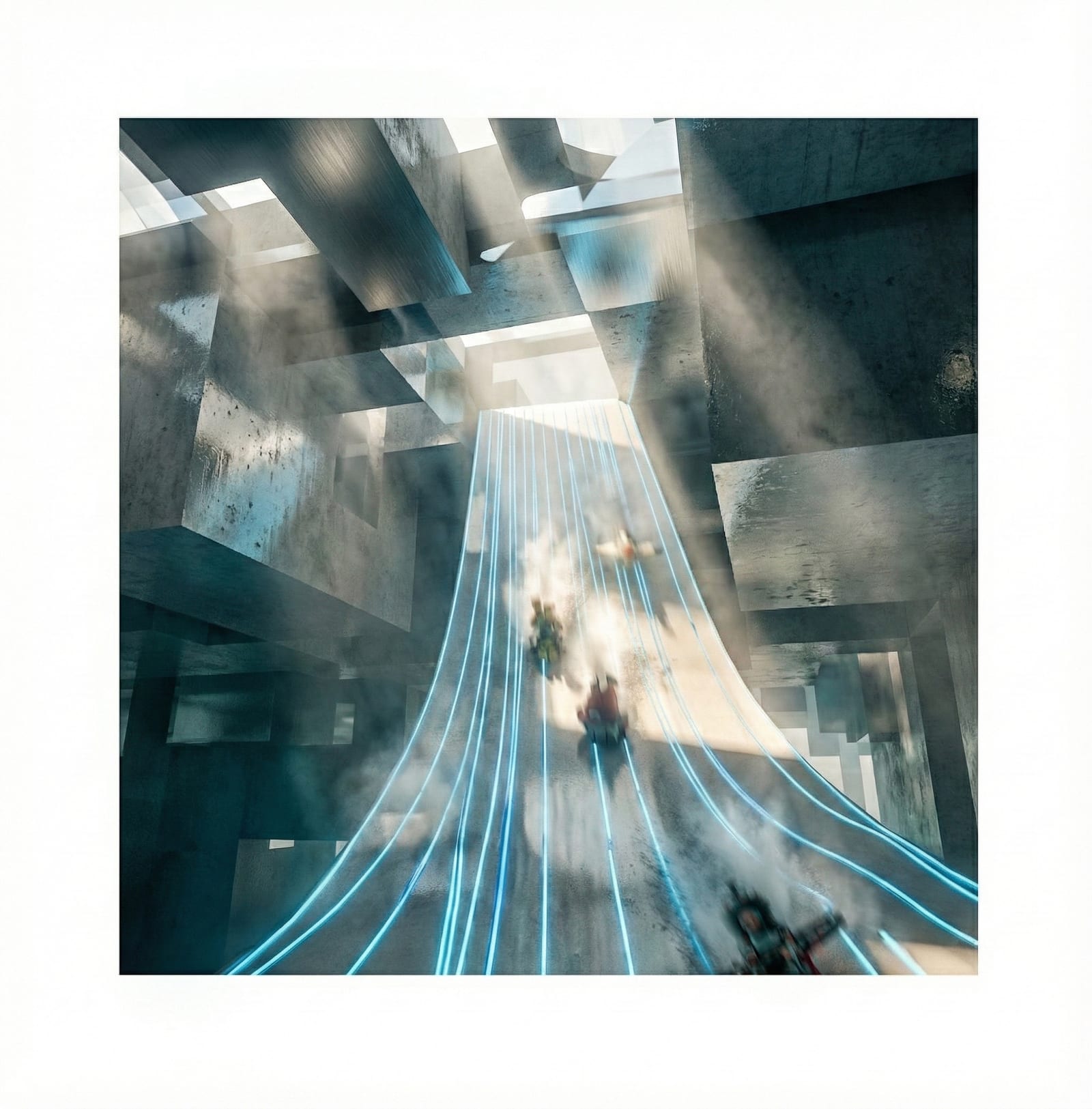
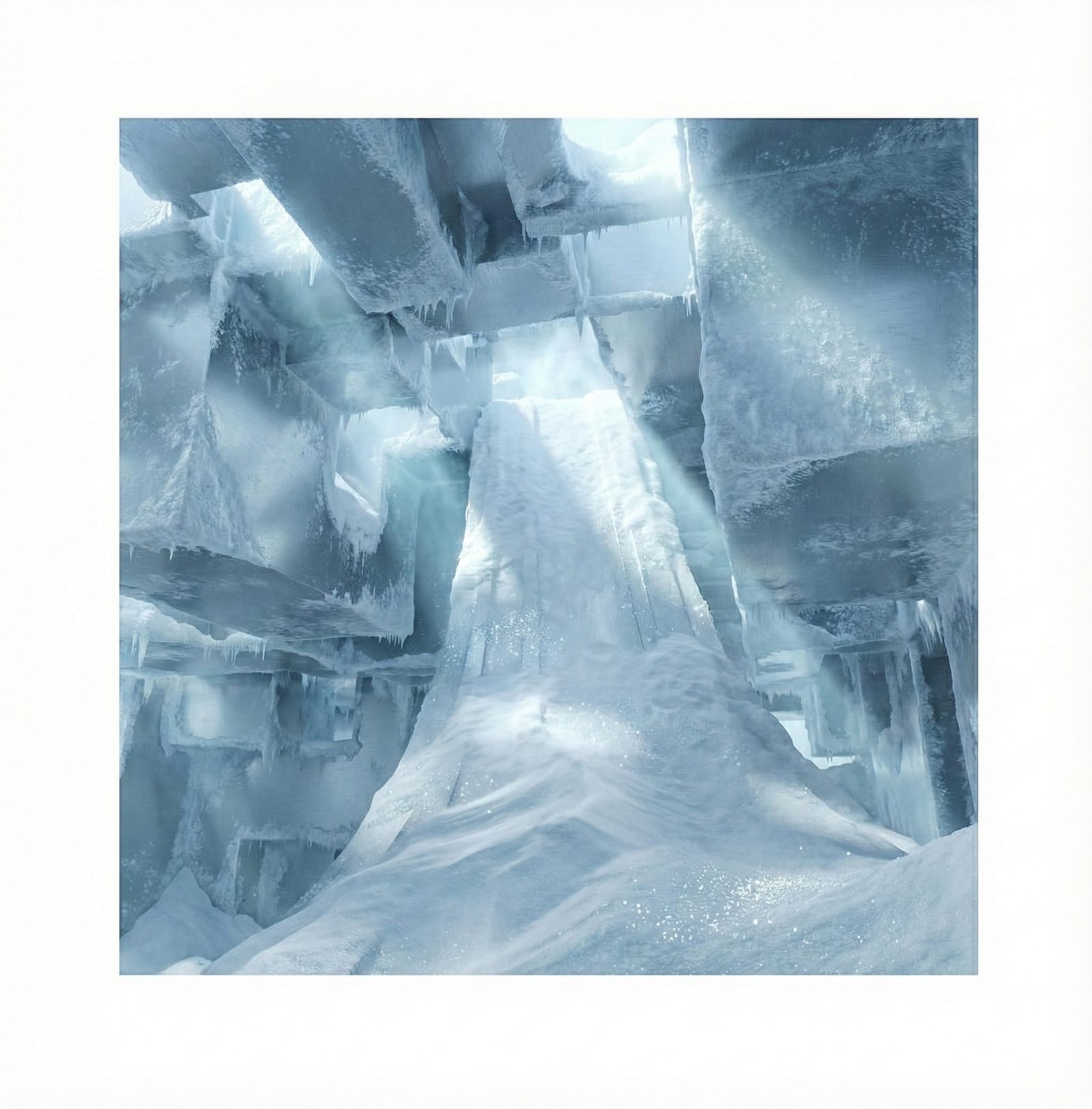
A block has two courtyards. On the south, a tropical forest: bamboo rising from roof reservoirs, a waterfall dropping from the fifth-floor overflow into a bathing pool, mist lifting from warmed water, temperatures in the high twenties, humidity at 80 percent, the smell of wet earth. On the north, an arctic chamber on the same morning: snow on the aluminum walls, ice forming on the floor, children sledding down a frozen ramp, breath visible, light refracting through icicles. Thirty metres separate the two. The heat pulled from the arctic courtyard is the heat that warms the tropical one. The cold is not a loss. It is the same warmth moved to the room that needed it.
By evening the tropical courtyard becomes a Mediterranean terrace. Warm stone, dry air, olive trees in aluminum planters, the evening sun coming in low at the horizon. The arctic chamber has opened onto a desert: quartz dust rising from heated air, dates warming on an aluminum shelf, a retractable skylight tracking the last of the sun.
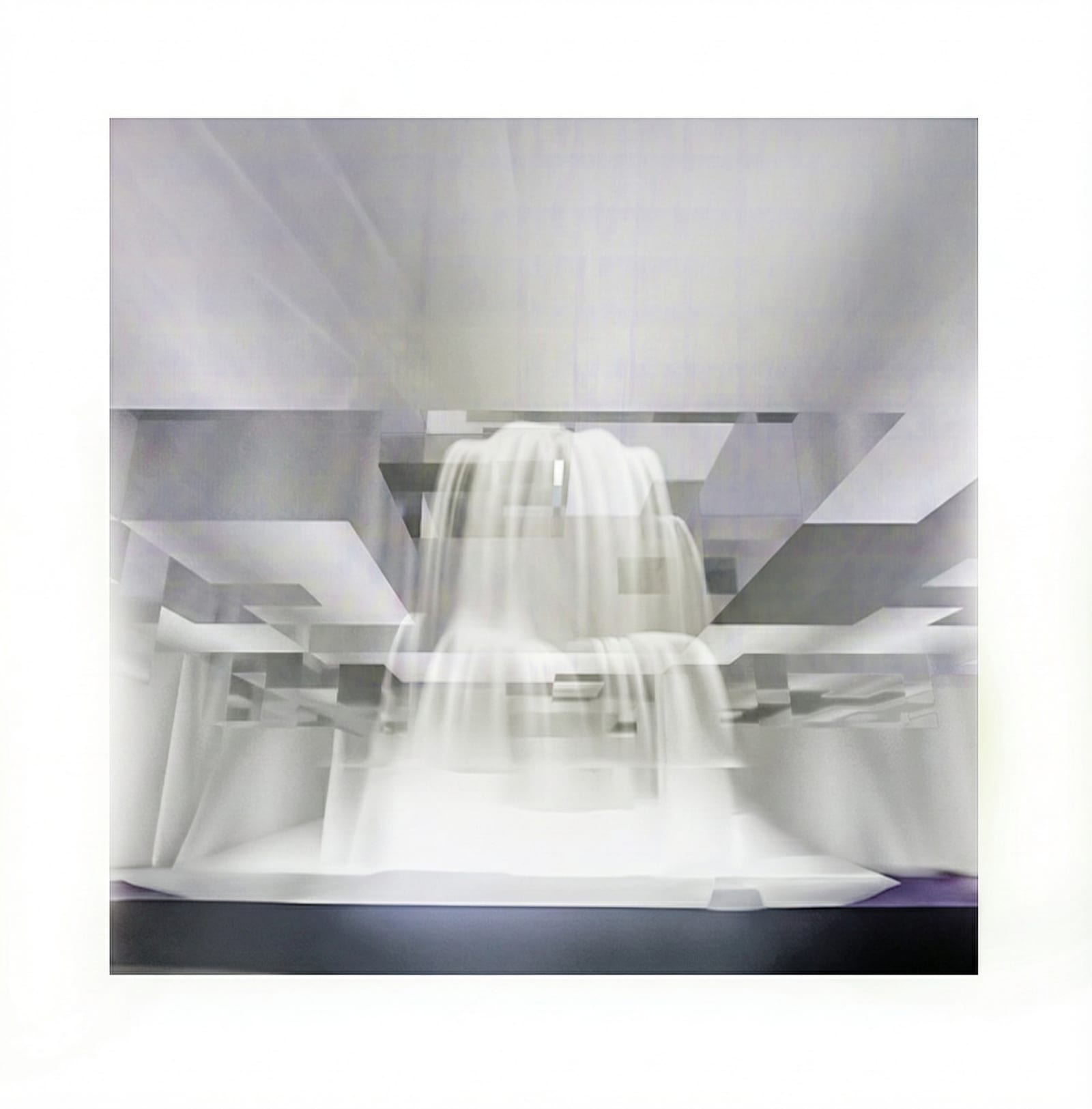
Tomorrow, either courtyard can be a theatre floor, a market, a lap pool, a ballroom, a forest, a ruin. A waterfall can be summoned in an hour: open the overflow valves, water pours down the aluminum face, light catches it from within. An ice cave can grow overnight: shift the heat outward, let humidity condense and freeze, sculptures appear on the walls by morning. A steam bath the same afternoon: return the heat, raise the humidity, the ice turns to cloud and the cloud to warm rain.
And the thing is free.
The panels are there anyway. The reservoirs are there anyway. The water and heat and electricity and air are moving through the walls whether the room is a bedroom or a forest. Switching the climate is not a feature bolted onto the building. It is what the system does automatically, because the flows were going to be there regardless. The architecture gives you weather as a gift, for the same price as walls.
A city could contain a desert next to an alpine valley. A library could sit under a rainforest canopy in January in Yakutsk. A Moscow winter could be crossed by walking through seven climates in a single block.
VI. The reflective city.
And the city becomes light.
Aluminum reflects 90 percent of the visible spectrum and 95 percent in the infrared. A courtyard wrapped in polished panels carries dawn to every window it can see. A stairwell surfaced in anodised aluminum delivers morning to a bathroom four storeys below. Light does not stop at the facade. It bounces, folds, reaches interiors that have no direct window.
A hallway lit by the afternoon sun three blocks away. A reading chair under a skylight that is not a skylight but a cascade of twelve aluminum reflectors tuned to catch the June sun at four degrees above the horizon. Starlight gathered by the roof and delivered down into a bedroom wall. A dinner table at which the wine glasses carry the last red of the sunset, held in the panel behind them.
At night the city becomes its own lamp. Interior light bouncing outward through perforated panels, aluminum lace on the facade, courtyards glowing from within, a block reading from outside as a lantern.
The surface of every panel can carry an image. An anodised aluminum ceiling can hold the mosaics of Ravenna, visible only when the evening light strikes at a certain angle. A corridor wall can remember a fresco in Tuscany. A child in Kommunarka reading, in January, under a ceiling that shows, when the sun is low, the blue and gold of Galla Placidia.
This is how culture moves through the building. Not as an image hung on a wall. As the wall itself.
VII. The gift.
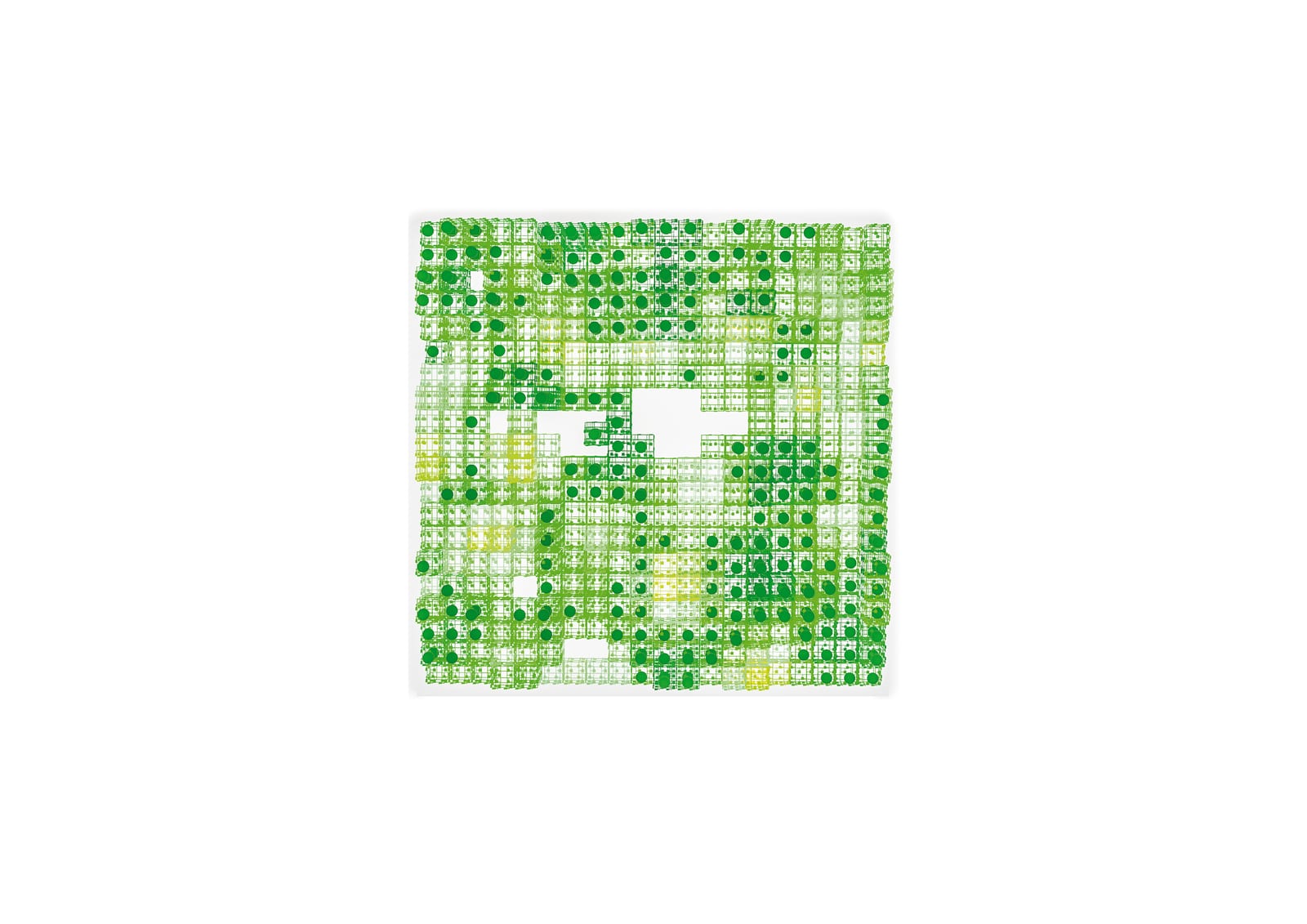
Every miracle in this manifesto comes free.
Not free in money. Free in logic. Once the panel carries the services, every extraordinary thing a building can do is a by-product of the panel already doing its work. The tropical courtyard and the arctic chamber are not two separate climate systems. They are the same system running in opposite directions across a block. The reflective architecture is not a cladding choice. It is what anodised aluminum does when it is cut and placed with care.
Think of Piranesi's prisons, but as rooms a child walks through on the way to breakfast. Think of the Alhambra's honeycomb vaults, but with Moscow snow outside. Think of the interior of a cathedral at noon, made from the same material as a ventilation duct.
The wonder is not ornament. It is the industrial side of the building doing its job.
VIII. The geography.
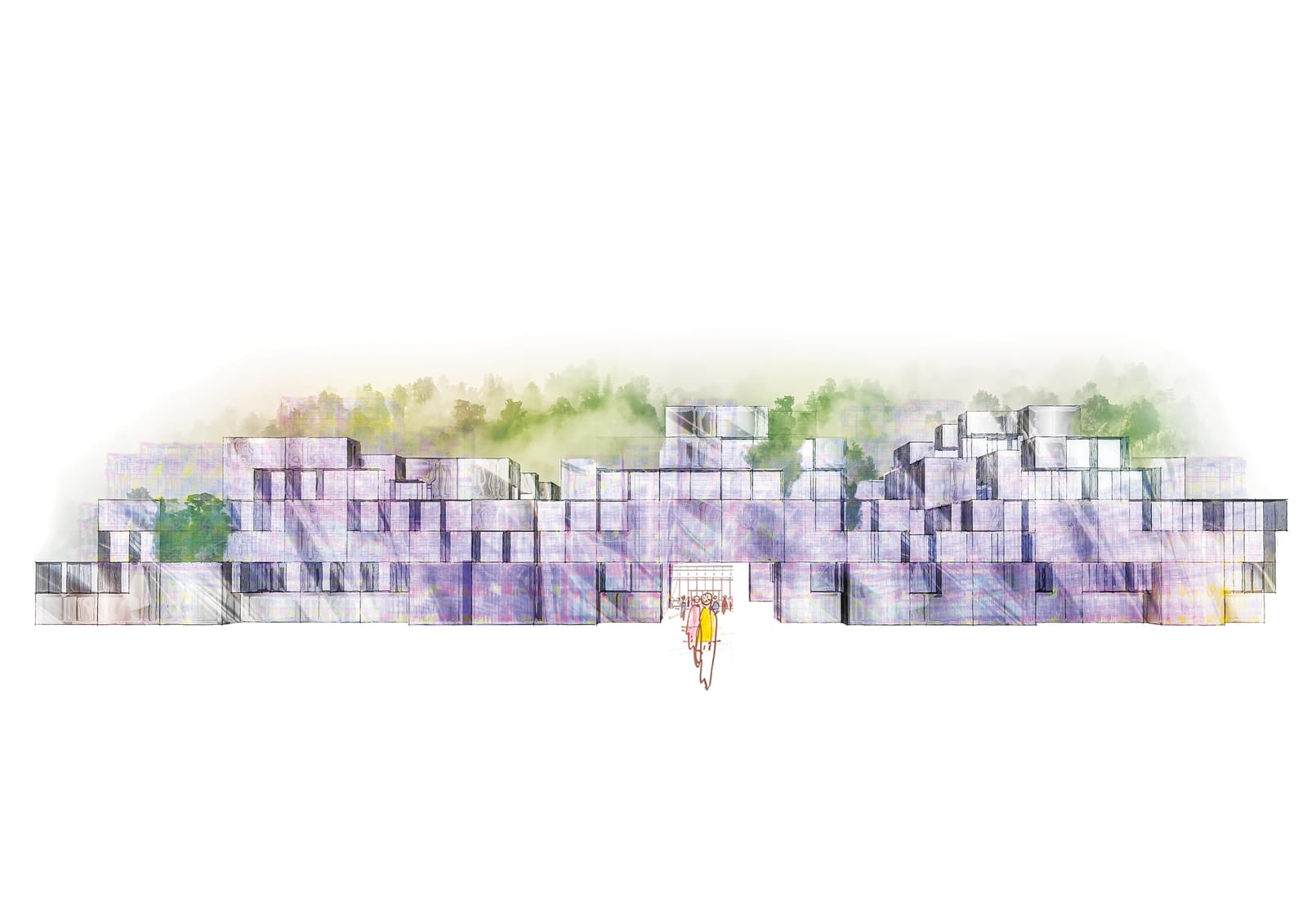
The material to build this is already being poured, on the Siberian hydro grid. Bratsk draws 2000 megawatts from the Angara. Krasnoyarsk produces a quarter of Russian primary output. Sayanogorsk, Novokuznetsk, Taishet complete the belt. TATPROF in Naberezhnye Chelny extrudes 25,000 tonnes of architectural profile per year. Alutech in Minsk carries a domestic thermal-break catalogue. The Schüco and Reynaers licensing inheritance, cut off in 2022, has folded into Russian factories.
The industry is skilled, coordinated, and currently underused by its own architecture.
If it coordinated with a single system house on a common panel grammar, the first building that is its own weather and its own light would stand in Kommunarka before any European competitor had shipped a pilot.
Not a forecast. An opportunity with a two-year window.
IX. Coda.
One element. One grammar. One wall that can be any wall.
A child in Kommunarka, in January, crossing seven climates on the way to school, under a ceiling that remembers the mosaics of Ravenna. A waterfall in the courtyard that means it has rained. An ice ramp next door that will melt by April and become a reading garden.
None of this is speculation. All of it follows from one industrial fact. The metal is poured. The grammar is waiting. Write it.
— Lex te Loo Architects, 2026
In collaboration with Anna Belashova and Kiril Shiryaev.